Saturday, 7 October 2023

Eye-browed Thrush in the garden.

I've found a few rare birds, should have, I've been at it for 62 years (I reckon to have started birding when I was six years old). I think this is the only mega though, a few BBs along the way, plenty of county level stuff. Of late, although I still go birding pretty much every day, invertebrates have been my main interest. 

Today started with moth traps, three traps two moths, somewhat disappointing, just Angle Shades and Small Wainscot. It was after breakfast, late morning that I noticed the Redwings dropping in. A few at first but then a flock dropped out of the sky, as they do. I had a couple of quick searches around the garden to no avail and then headed for the coast where there was no obvious incoming of migrants.

At home again lunchtime and more Redwing activity with further flocks doing the dropping out of nowhere. We have Swedish Whitebeam in the garden and they were an obvious target, berries were disappearing at a rate. But, each time I went round the trees the flocks headed off.


Redwings scoffing Swedish Whitebeam berries.

There was also a bit of Swallow movement, a House Martin, Pied Wag and a few other bits and bats. However, I've been looking for moth larvae recently so elected to head off down the hill, check The Shunan and wander across the fields. Target species Chlorophora glaucicolella.

Dipped on the moth, couldn't find appropriate food plants. And eventually headed back up the hill to the house via a few diversions.

Redwings were very evident in the back garden and in between tea and cake and more tea I kept checking them. Hummed and hawed about going out on the bike. Had another look at the trees. That's odd, that Redwing has no breast streaks, and it's all red-brown down the breast (it was face on). It went down on the ground in the vegetation, definitely no breast streaks, neat little wing bar, rather different face markings, more restricted, less clear. Grabbed the camera which was handy and managed to fire off a few shots. Look at the camera back, no I wasn't imagining anything. Now wracking memory... too small and not right for Red-throated Thrush. Grab the book (Wildguides is always on the kitchen window ledge) .... various expletives. Fumbled the phone. AL lives just 10 mins away, gave him a ring.


Eye-browed Thrush first images.

When AL arrived he confirmed that I wasn't mad. And it was general relief when both AL and Louise had confirmatory views and we got some better images.  At this point I put the news out on What's App.


Eye-browed Thrush

A couple of folk quickly arrived for the twitch but all the time the light was failing and the bird, having presumably stuffed its wee belly with berries was showing more intermittently and briefly. Last seen a bit before 5ish.

Well that was a bit of a do. And I didn't see a Greenfinch all day (again).

Friday, 6 October 2023

Seek and you may find...

And if you don't look you won't find anything!

Despite dissecting a good few berries I couldn't find the culprit that appears to be burrowing into them.
 
The Hawthorn hedge, where there are a few berries to check.
 
The damp fields below the house are full of Juncus effusus, Soft Rush. Last year I found the case bearer Coleophora alticolella for the first time, after I'd been given the heads up to look. Just examine the seed heads and you should see little "rice grains". I've looked for this year in the last few days and found them again, in their hundreds. Examination has again, so far, just found the one species of moth C. alticolella, there is a congener that behaves in a similar manner, the caterpillars are separable with careful examination.
 

That may be a Hymenopteran egg on the case. A number of species parasitise these caterpillars. I was led to a Durham University PhD paper about the development and parasitisation of C. alticolella which was an interesting read.

Coleophora alticolella, lateral scleretised spots reduce in size S1 to S3, oddly this one did not have a sceleretised spot on abdominal S9.

These flies, big and buzzy, have been around the entrance to the moth trap at night. Eventually, I managed to catch some and with help, thanks SW, got to the identification of Polietes meridionalis, a species only identified in the UK in 2015. There is a congener, P. lardarius, but I haven't found that yet. To be honest they're a bit of a pain, buzzing around the entrance to the trap, and they are large. Identified by the yellow face and yellow front thoracic spiracle, those bits are grey on P. lardarius.


Polietes meridionalis.

Another light trap intruder, found when I was cleaning it up later on was this Psocoptera (barkfly).


Graphopsocus cruciatus,

The last new insect of the week, well there will be more once I get around to all the Hymenoptera, and there was a beetle in these Gorse pods as well as this caterpillar of Cydia ulicetana.


Cydia ulicetana in Gorse seed pod.

On the bird front the Pink-feet are arriving, flocks on three days in a row.


Pink-feet arriving.


Reed Bunting, numbers increase in October with some migrants arriving.


Pied Wagtail, birds moving through and numbers decreasing through the month.

The moth traps have been having some long overdue maintenance. Checking wiring, replacing connections etc. I temporarily swapped the 20W Wemlite, which I've used for a long time and is rather wobbly for a newer model. It didn't last long.


Water most likely the cause.

So I ordered some new bulbs from Paul Batty - http://www.pwbelg.clara.net/mercury/ and a new bulb holder, a ceramic one just in case I do want to run an MV. I managed to get the last 20W Wemlite in stock and a 13W version to test. But I also thought I'd have another go with an LED, my previous one I used years back was not a great success but these 9W ones look as if they may be the business. The plan is to have a bulb holder by the back wall that I can keep an eye on, as well as the usual traps. A 9W LED will go in combo with a synergetic in my Robinson.

9W LED, 20W Wemlight, bulb holder and 13W Wemlight.

And here's the Sun partially obscure (not by clouds!) but by North American smoke.

The Sun

Tuesday, 3 October 2023

Autumnal(ish)

Warm yesterday, sitting outside with tea and home made scones in the late afternoon, without a coat.

It is autumn though, there was a Yellow-browed Warbler in the garden the morning the day before. It happened to have a burst of calling from the clump of trees where I see most warblers in the garden, and I managed to glimpse it. Not much else of note though, there are ducks on The Shunan, a tagged Buzzard hanging about, a Shortie the far side of Bosquoy from my bike ride and a flock of 52 Linnets.

Moths have been few and far between, but in perfect conditions last night, other than rather a lot of rain at some point, I got something interesting. At first glimpse in the trap I thought it was a 2nd gen Common Marbled Carpet, but more careful examination of the images later proved otherwise. NFM and this for the site Grey Pine Carpet.


Grey Pine Carpet, Thera obeliscata.

This species can be a bit of a tricky ID, I think mostly in it's grey form, it can be almost indistinguishable from Spruce Carpet, and dissection of the genitalia apparently doesn't help. However, T. obeliscata males,have plain antennae with symmetrical segments whilst T. britannica males have asymetric antennal segments. Unfortunately this was a female when I checked, I had initially thought it to be a male. 

Fortunately a number of folk came to the rescue and especially SS who very kindly annotated a number of his photographs of both T. britannica and T. obeliscata and confirmed the above as Thera obeliscata. Excellent!

Thursday, 28 September 2023

Muddy.

We were staying in Grinton in Swaledale near relatives and a short walk from the Dales Bike Centre. My Specialized Rockhopper Comp didn't come with us but was in Kirkwall for a service, I thought I'd have a day out on an eMTB. I've been admiring the Trek Powerfly range in Inverness recently as we've passed through and DBC have some Powerfly 5s for hire. Orkney is relatively flat and the trails I cycle are not steep and only occasionally slightly technical. When we lived in North Yorkshire it was so steep around our house that I barely went out on my bike (the faithful Kona Lavadome I've owned since the 1990s), the Grinton area is similarly challenging with some steep, long climbs to get on the tops. One of the thoughts around the eMTB plan is to dispense with one of our cars and replace it with an ebike. 

Selfie, on the tops.

Briefly: going uphill is a revelation. I stayed in the lowest two settings all morning, used very little battery (a fifth), climbed everything I attempted and went miles and miles; the Trek is a heavy beast at 22.5ish kg; nipping from Grinton to Settle and back for the shop was a short breeze; it was a hell of a work out, 5.5hrs on the bike, and some really decent climbs which the motor takes the edge off; descending was body battering, especially the upper body and on steep descents the bike is almost uncontrollable due to the weight and the brakes locking (Canyon make a bike with ABS which would be handy).

On top.

Conclusion: I'd like one, but if in North Yorkshire I'd go for full suspension (more control, less hammering of the old body). A hardtail eMTB would be ideal in Orkney and would comfortably replace a car, the extra weight being handy in the wind. Not many eMTBs have fittings for racks etc, Trek and Specialized do. The Bosch motor and easily removable battery are big pluses for the Trek, Rockshox fork for the Specialized. 

Whilst on the tops I found a pair of Ravens, I really can't remember when I last saw Ravens in North Yorkshire, but they do wander at this time of year. There were also Red Kite and Buzzard in one spot. However, the Red Grouse situation was mad. Many, many flocks of 15 to 20 mostly undersized birds, I saw hundreds during the morning. Most of the moorland is just a giant Red Grouse farm, like the fields around our house in Orkney for sheep and cattle but instead Ling kept short. I don't remember it being like this before, twenty years ago. I came across two shoots. I can't see the "sport" in this, the flocks come up from under the wheels, some individuals you can almost pick up. Aside from the aforementioned species there were lots of Meadow Pipits but otherwise one Kestrel and one Golden Plover made up the whole list for the morning on the tops. It all stinks of money and privilege. This in the Yorkshire Dales National Park, a complete travesty, the moorland should look nothing like this. And I do not have a "problem" with shooting per se, I do have a problem with environmental devastation, particularly in the light of the plight of most of our native species and the climate crisis. (I could also have a rant about the Pheasant industry and the impact of that but...) Most of the trails I rode have been "improved" for shooting access, scars on the landscape from my point of view.


In the afternoon, following meeting up for lunch at the DBC's rather good cafe,  I toodled off to the other side of the dale and to the old lead mines. More shooting going on which I managed to avoid.


Here I did find some more natural trails and got muddy on some very claggy bridleways. Also, nearly came off on a very, very steep piece of downhill road with loose surface. So Trek Powerfly 5 = 8/10, Yorkshire Dales National Park (Government) management of this fabulous place = 3/10.

Tuesday, 26 September 2023

Yorkshire Moths.

We went to Yorkshire for a week. I took two Heath traps with me and trapped in the two gardens that I used in October 2021. The first night the garden in the village did well with NFM Shuttle-shaped Dart and Light Brown Apple Moth, which I don't think I've seen previously. Brown-spot Pinion were in both gardens and also new I think. Earlier in the day a leaf mine in a cherry (Prunus), in the garden up the hill, was from a Stigmella species I thought, feasibly, S.oxyacanthella. And a small brown job eventually turned out to be Beaded Chestnut. So a good do!

Beaded Chestnut.

Brown-spot Pinion

Cherry leaf, upper.

Cherry leaf, under, mine maybe from Stigmella oxyacanthella, re-identified, thanks CC, as Lyonetia clerkella.

Light Brown Apple Moth, Epiphyas postvittana.


Shuttle-shaped Dart.

Other species seen or captured included: (up the hill) Red Admiral, Nettle-tap, Silver Y, Setaceous Hebrew Character, Blastobasis adustella, Large Yellow Underwing, Lesser Yellow Underwing, Dark Arches, Large Wainscot and Common Marbled Carpet; (in the village) Green-brindled Crescent, Yellow-line Quaker, Red-green Carpet, Autumnal Rustic, Diamond-backed Moth, Common Wainscot, Blastobasis lacticolella, LYU, DA.

Common Wainscot - upperside of hind wing examined and was pale.

Brindled Green Crescent.

(Red-green Carpet) or maybe Autumn Green Carpet - thanks SS. Unfortunately I didn't photograph the hind underwing. I did photograph Red-green Carpet on another date, to be added.

Silver Y

Yellow-line Quaker.

The next night it rained a lot, late on. I brought the moor side trap in very early, and the village trap a few hours later. The moor side trap produced a very nice Least Yellow Underwing, Noctua interjecta. I took a specimen of this as the ID required good views of the upper side of the hind wing.


Female genitalia

Wings, uppers, fore (top), hind (below). The hind wing confirms the ID. Fore wing length14.4mm.

Pretty chuffed with this, a decent record and NFM.

However, more good stuff to come as when I brought the village Heath in there were some moths in the mouth of the trap and on the wall, nearby.


Canary-shouldered Thorn, male, very nice, it was in the mouth of the trap.

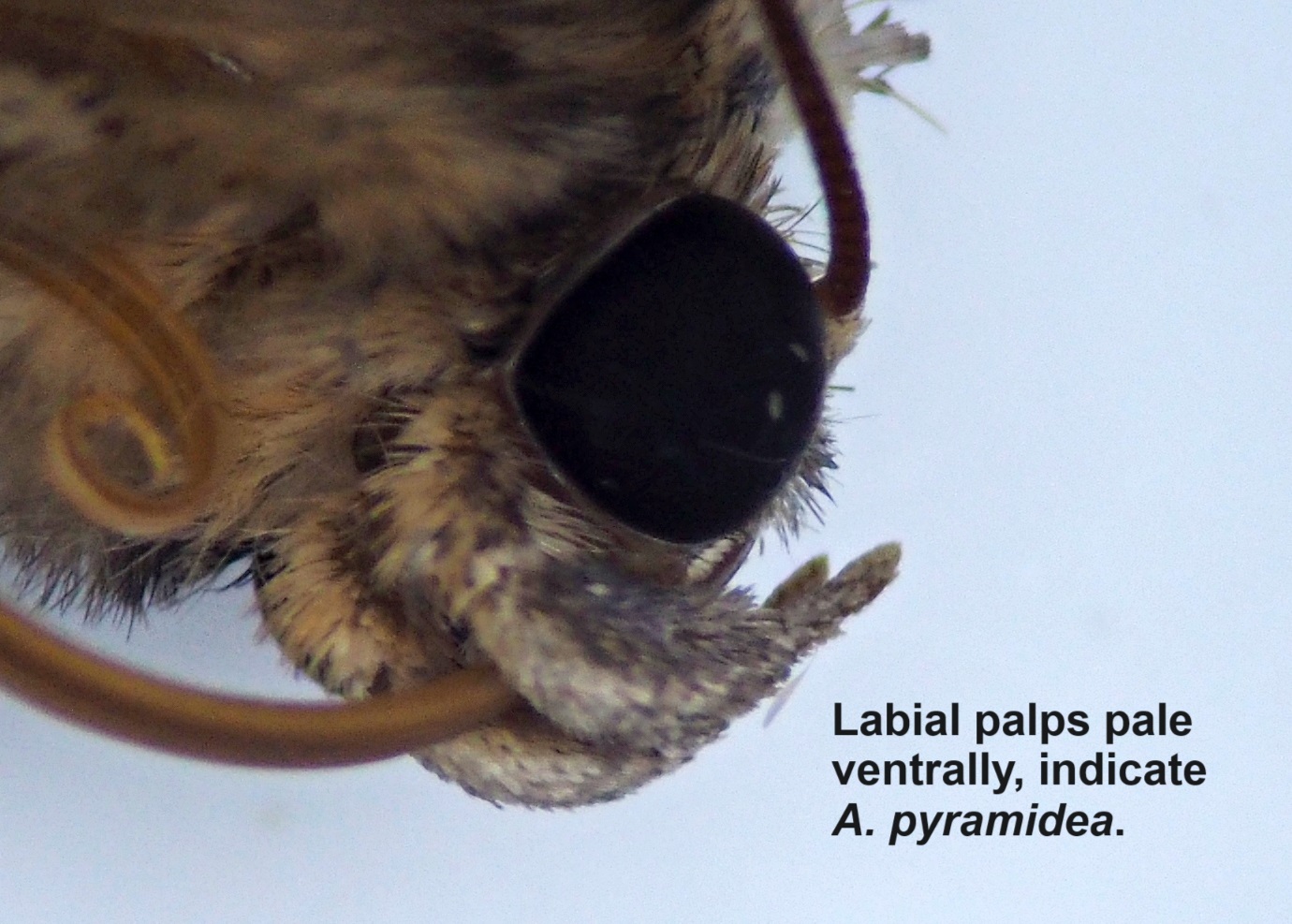
And, there were three Copper Underwing agg on the nearby wall. One escaped but I captured two rather worn ones. A bit of a tricky determination these, especially as I'd not seen one before. I took the specimens and brought them back home for some dissection.

Head to show labial palps, which were pale below.

I broke the aedegus whilst opening it and the top lot of spine-like cornuti should actually be under the lower set, anyway, there are just 11 or so of them and not 30 so that makes this moth A. pyramidea, Copper Underwing

Male genitalia with the aedegus in place.

The uncus is the top bit that is hanging down, this is a lateral view.


So this all adds up to this one being Amphipyra pyramidea, Copper Underwing, as opposed to A. berbera, Svensson's Copper Underwing. Again, good result.

The second moth was a female, on this one the wing colour was a bit more helpful, handy as I wasn't gentle enough with the genitalia dissection and distorted the crucial bits.

Fore wing.


Copper Underwing.
Also in the trap A Yellow-line Quaker, two LYUs and a Common Marbled Carpet.

I didn't trap the following night but on the night of the 20th the moor side trap produced, Red-green Carpet, Yellow-lined Quaker, 3; a Canary-shouldered Thorn, Spruce Carpet, Common Marbled Carpet, and a Feathered Thorn, plus another Copper Underwing, another male.


Despite the wings being inconclusive, the other factors allowed identification as A. pyramidea.

Canary-shouldered Thorn

Spruce Carpet.

Feathered Thorn

Yellow-line Quaker