Friday, 1 December 2023

Orcas (but dipped the Humpies)

There's been a bit of cetacean activity in The Flow recently and I've kept an eye on the local group news channels. Things looked interesting this morning with Humpback Whales seen yesterday and Orcas reported this morning. When I saw the message that the Orcas had headed across from Hoy into Bring Deeps I gambled that they might head east towards Hobbister. These guesses often don't pay off, Orcas are not the most predictable of beasts.

After a drive and a tramp with the hound I got myself perched on an appropriate cliff top and started scanning. It didn't take long to find distant Orcas.

Male Orcas heading towards Scapa.

I was tracking these two and also looking for the Humpback Whales which had been reported from a little further east but at a similar range. Also distracted by weird Grey Seal behaviour, noisily occurring directly below me.

Of a sudden I heard a familiar sound very close, the females and young of the Orca pod had coasted east and were immediately below me. Darn! I'd a good view to the west and had completely missed them arriving. Grabbed a few very hasty shots and rubbish video as they rapidly disappeared.


This is possibly 27 herself, she's the boss of the 27s and had a calf about a year or so ago.

 ...and all too soon they were gone.

Not very good video of the pod disappearing into the distance.

An explanation of this behaviour would be of interest. Every time the swimming seal approached the one on the rocks blew more bubbles. Is this aggression or courtship? Or something else entirely?

Yesterday evening I had a scout around with a torch and camera looking for moths. Winter Moth was the target species, with vague hope of Scarce Umber. It was a bit cold, but I did find two Mottled Umber.


Mottled Umber.

Top notch flash diffuser I used for these moth shots, baking paper roughly folded, masking tape. Hi-tech.

One of my E-M5 Mk11 camera bodies played up a bit recently. Subsequently it's been ok but I'd resolved at that point to upgrade. One of the issues with the E-M5 Mk11 is the tracking of birds in flight. Whilst better than the various Canon compact cameras I've owned previously, including the M series, it is still not the best. I've been on the hunt for an Olympus E-M1 Mk11, still old technology but reputed to be the best "bang for the buck" going. I finally found one I liked the look of on MPB, and when it arrived it looked brand new and the mechanical shutter had been fired fewer than 800 times. I'm still getting used to it as there are significant differences from the E-M5 Mk11s but getting there. The Orcas above were taken with the new camera. Here are a few other early efforts.

Golden Plovers in flight.


Harbour Seal.

The Great White Egret was absent today, but so were the ducks as The Shunan is frozen. I suspect it is stalking around in a burn somewhere.


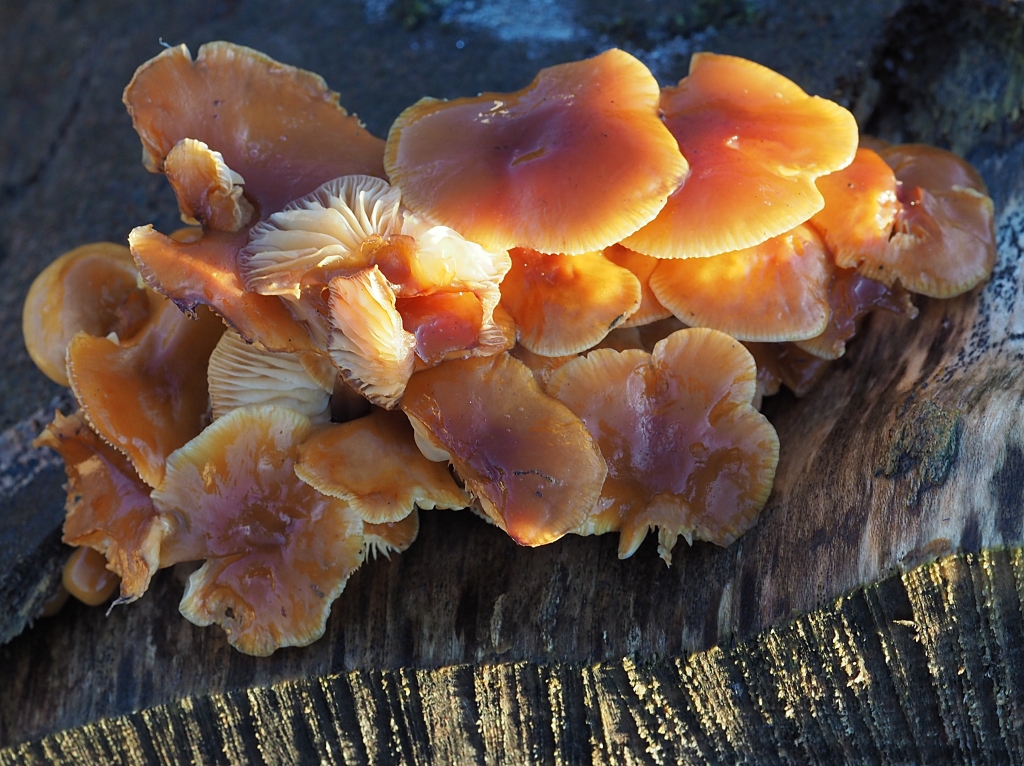
I came across this bracket fungi today, I need to try to find out what it is.


Time to head to the Danish fungi picture ID site (see side panel).

The hound, not so interested in Orcas and Grey Seals, much more interested in Woodcock and Red Grouse, which we also saw today.


Monday, 27 November 2023

Confusing critters.

 Some identification issues this week.

Lesser Black-backed Gull, re-identified as a Herring Gull, 1cy; thanks to folk on Western Palearctic Gulls FB Group for helping me come to the correct conclusion in the end.

Leebs are uncommon here in Orkney in winter. When I do see them they are usually young birds, looking a bit odd or unwell. But until I found I had a 90 degree on image and could assess the length of the primaries I was struggling a tad with this. I did wonder if I had found a Yellow-legged Gull, a real rarity here; very much a rarity, there are no records. Anyway, I did work this out in the end (some folk think this is a Herring Gull). The oddly shaped bill is because there is a water droplet on the bill tip.

Back in June I photographed a pug, one that doesn't yap or bark, a moth, on Hoy. Here it is.

Satyr Pug, Eupithecia satyrata (Thanks to RL for the identification.)

I'd proposed Foxglove Pug. It had then been identified as Edinburgh/Freyer's Pug (Eupithecia intricata). However, as this would have been a county first I needed to get it checked. Re-identified as Satyr Pug, it lacks the dark band across the base of the abdomen that is diagnostic for Freyer's Pug. I had a good look through the images on both British Lepidoptera and on Lepiforum, and although the band can sometimes be hard to see it is usually obvious. Freyer's Pug is a species that is likely here in Orkney, one to look out for.

In recent days I've also been shown images of another mystery pug. The trapper thought it was a good one, so I sent the images off for identification and verification. It has come back as Golden-rod Pug, new for the county, an excellent outcome.

The Great White Egret, or indeed two of them, are still about. Mostly, like today, I see one, but two were here yesterday. If I take the binoculars upstairs I can often see one whilst sitting in bed with a cup of tea.

This was photographed nearby, in Dounby.

The tick of the week was a small cranefly, Trichocera major. I must capture another to photograph a bit better, but I had two in the light trap a week ago. I had thought that I had a new fly for Orkney but had again been pipped at the post by BH who had caught and identified this species a few years back.

Trichocera major, not the best image.


Trichocera major, thanks to BH for confirming my ID.

There were just four moths, none in the trap, all on the wall or on the trap. Three Mottled Umber and an Angleshades.

Angleshades.


Mottled Umber, a dark one and a pale one.


Harray Kirk, photos from the garden today.


Wednesday, 15 November 2023

New garden bird - GWE (close anyway).

Pretty sure one of today's Great White Egrets entered "air-space" above the garden. I was too busy trying to get photos, but on flight path I'd guess it made it. A beautiful day, and my usual morning stroll down to The Shunan to count the ducks and waders was enhanced by not just one, but two Great White Egrets. This species first graced the patch list in August last year, indeed it got on the "from the garden" and "from the house" lists too. At the time it was a first for my "self-found" list. I know that south this species is these days pretty much two a penny, but here it is still a quite scarce bird, so chuffed.

GWE x 2 at The Shunan.

One bird was bullying the other, presumably this is a survival strategy to keep a feeding place for itself. The dominant bird seemed to be tucking in to sticklebacks and didn't waste too much energy chasing the other bird which shortly left to the east, and in the process seemed to get itself directly over the garden, close, anyway.

GWE leaving air-space.


As we headed out to do the recycling the dominant bird was conveniently on the road side of The Shunan.

I watch Blackbirds scrapping over apples in the back garden. It occurs very regularly, even when there's plenty of apple for all. And Robins are not at all keen on Blackcap feeding on apple, although the Robins themselves are not all that interested in the fruit and only take the occasional piece. There would have been plenty of feeding space and plenty of sticklebacks and probably Eel for both birds.

Sadly the Nikon 50mm Fieldscope was a right-off. Not repairable. Fortunately I'd pre-empted this eventuality and having spotted what looked like a brand new body on eBay acquired it for a very good price. When it arrived I was very, very pleased to find it was pretty much brand new and unused. Using it I've now realised that my old one had been pretty knackered for some time. Nikon have been good enough to give me a 20% discount voucher as they've recycled my old one. Nikon service for optics has in my experience been spot on. No carriage or administration fees (Leica) and dealing with Nikon direct, not a third party agent (Kowa). I suspect my next bins will be Nikons. Having said this we've just replaced Louise's Opticrons with a pair of Zeiss Terra 8x25s, they are fabulously sharp. A bit bulkier than pocket bins, but easily stowable for traveling. 

The last few days have been spent looking back at photos from our 2021 Arran trip and trying to sort all the identifications. I've been motivated to do this by the Bubo Pan-species Lists being put online, what a great project! This has generated guilt at never entering much of my Arran data into iRecord. However, to tackle that omission has proven easier said than done as there are a lot of identifications that I need to review. So far I've found five new species for my PSL and corrected one significant ID blunder. Earlier trips to Arran also require review.


Athalia cordata (Bugle Sawfly) from Arran, July 2021 (thanks to AR for help and confirmation of the ID).

I'm sure there will be a few more (not exactly armchair) ticks. Each requires a fair bit of messing with photos and then research to get to a species identification. In one case I'd kept a moth specimen, it had been in the freezer for two years, and I've finally got to the correct identification. However, there are some others that require some help and consultation.

Tinea semifulvella, I'd previously thought this was a Batia species.

Our trip to the tip involved a stop at Warbeth for a walk, where there were a lot of Ringed Plovers, about 140 and a single Grey Plover.

Some of the 140 or so Ringed Plovers with one Grey Plover.


Rain Over Hoy.


Thursday, 9 November 2023

Weather - spaced out!

 Nice aurora on the evening of 4th November. I pottered out and took a few pix after younger daughter, who lives south, had alerted us to the lights.


Our house with the aurora behind.

And again...

Aurora and shooting star.

There is a bit of an issue with dust on the camera sensor with night photography; irritating, the images take a lot of cleaning with my software (Photoscape X, free). And i do clean the sensors, but it's tricky.

These images are not much meddled with in the software though, other than a bit of cleaning, and some cropping. I like to try and keep them as much as possible as they came out of the camera. The aurora doesn't really look that green to the eye, the camera exaggerates the colour. The aurora just looks as if it isn't as dark as it ought to be for the time of night, and then the brightness moves about. 

The next night things went a bit bonkers. The Weatherman mentioned more aurora in his report, we checked the app and yes it was a red alert.

This is probably the second brightest aurora I've seen since we've lived here, it was all around us, not just to the north, and it was very active at times, flashing and moving. Some colours we certainly visible to the eye. Again, with the photos I've tried only to clean and manage the images a little, not go for massive effect.

Aurora over Dounby.

Our house with aurora to the north.

Aurora to the east, our neighbour's trees, the rookery.

And again...

Aurora to the west.

The weather itself has been pretty odd, no wind, just still for days. Today was the first day for ages with any kind of breeze, and that died away for the afternoon.

Still water and lots of reflections led to a few attempts at photographing the landscape.

A moorland pool, Swannay Loch and the Hoy Hills.

Swannay Loch.

The view north towards Eynehallow and Evie.

We'd walked to the trig point at Costa. I'd never been there before, it is a slightly awkward place to get to with limited parking and a bit of a walk along the road to get to the footpath.


Louise walking back to the trig.


Moorland pools and the Hoy Hills.

 The day before we'd walked up to the Birsay Moor trig point. Another place which is slightly awkward to access. Jack Snipe, Snipe, Raven, Reed Bunting and male Hen Harrier were the only birds.

 Further expeditions were made. An evening outing to check on the Barn Owl drew a blank for that but I did relocate the Great White Egret, back at its original location, seen flying in to roost.

Loch of Wasdale.

A trip to Dounby by bike to the post office involved a diversion to Loch of Sabiston, just checking for egrets, but there were none. Just two flightly Waxwings in Dounby village.

Broken tractor, Dounby.

The light traps have produced just a few Mottled Umber. Unless I get a very warm evening now I probably won't use the light traps now for a while; unless we head south of course.


Mottled Umbers and slightly sinister thoracic face.

The only other beast of special interest was a Staphylinid beetle, I found this in leaf letter whilst looking for moth pupae. Always a slightly tricky ID but this is the species of this genus  these generally turn out to be here.

Lesteva sicula, 3.5mm, a small beastie.

The pits on the elytra, how large, close and deep they are are needed for ID, and can only be seen properly if the elytra is spread or detached. The short antennae and shape of the pre-apical segments are also very useful for identification.