My kitchen rocket plant which has attracted so many hoverflies to a
sheltered spot just by the front of our house over the last couple of
years did not reappear this year. Last year we tried growing some
Nicotiana in the vague hope of attracting Convolvulus Hawk-moth (bit of
wishful thinking I know), the plants did grow and flowered at the right
time but didn't really attract much, let alone the hawk-moth. This year
we tried some dwarf sunflowers, some in pots (currently tucked away in
the conservatory so the wind doesn't destroy them) and some transplanted
into the veg patch (fingers crossed with those). I also came across a
random crucifer and put it in a corner of the bean patch. The last
couple of days have shown the value of these plantings.
Sunflower and Episyrphus balteatus
Two Episyrphus balteatus and a Syrphus sp on the crucifer
Female Eupeodes corollae on the flowers (id the yellow runs across the margin from upper to lower body surface).
Female Syrphus, either vitripennis or torvus, to get to species level need to see the extent of the tiny hairs on the 2nd basal cell of the wing, a microscope job.
Out and about down the track and around the Wee Wood there have been huge numbers of hovers. Cheilosia illustrata has just begun to be seen in some numbers. It is a small and not especially good mimic of bumblebees.
Cheilosia illustrata on Hogweed
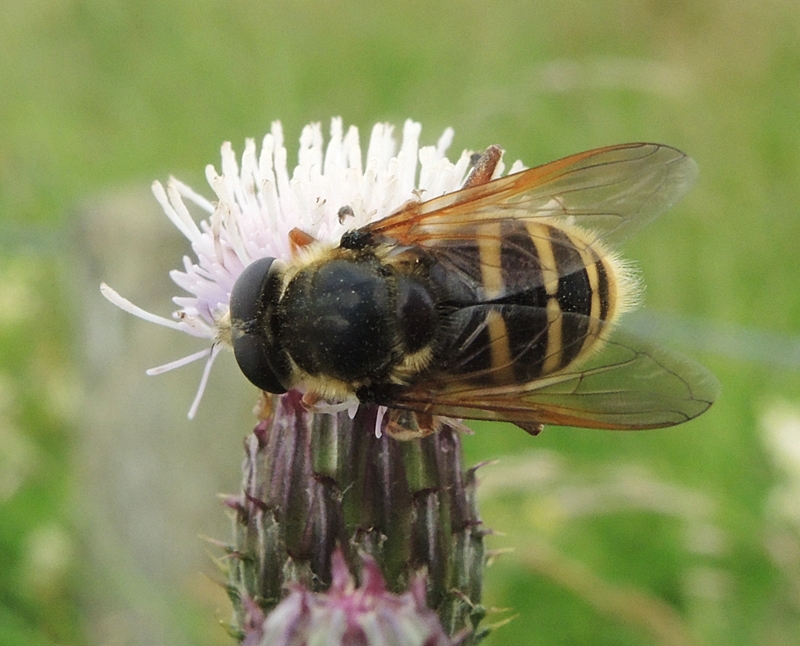
Most hovers were on Creeping thistle heads.
Creeping Thistle by the side of the track
I counted 139 Helophilus pendulus between the Weee Wood and the hawthorn hedge, but there were 100s more than that I suspect.
Helophilus pendulus mating
In amongst all the H.pendulus I did find this pair of Helophilus hybridus. Black line between T2 and T3 absent in male and hind tibia with apical half (rather than third) black. I usually find that the stripes on the thoracic dorsum are less bright.
H.hybridus, pair mating and Empis livida
Syritta pipiens showing the enlarged hind femur
Syritta pipiens and thing (LJ can you get that to family?)
Sericomyia silentis a wasp mimic
Male Platycheirus manicatus, front tarsi enlaged, dull thoracic dorsum, yellow/orange and black
Female of the same species showing the sticking out face (females do not have enlarged tarsi).
There have been some good moths lately as well, I'll post them shortly.
Windy and quite wet here today, not much good for insects but I got a new bike the other day, well I've had the Kona for 26 years so I don't think I'm being too extravagant and got a good deal via the Cyclescheme (tax free (ish) purchase). So time to get muddy...