Sunday, 14 May 2023

Gone.

The male Brambling that arrived here on 5th February, joining a female present at the time, has finally left, last seen on 11th May. The female long-since left. Hopefully the male is winging its way northwards but the male Sparrowhawk that has been hunting the feeders recently might have gotten itself a rather colourful meal.

Brambling male.

Otherwise the feeders produced the first warbler of the year, a Blackcap and a Tree Sparrow was present for an hour or two.

Tree Sparrow right, House Sparrow, left.

Blackcap, male.

Arctic Terns are now present on Bosquoy and sometimes on The Shunan, Greenshank, Common Sandpipter, Ringed Plover and  Dunlin have been recorded for the year and 11 Blackwits briefly graced The Shunan. Most extraordinary though was the first patch record of Turnstone when a small flock of four flew through Bosquoy, probably flushed from the wadery bit by a Bonxie. Two days ago the first singing Willow Warbler, just on the very extremity of the patch and four Sedge Warblers on territory.


Sedge Warbler.

There was a brief hirundine flurry, with plenty of birds on Bosquoy and Louise heard a Cuckoo up, behind the house, I dipped (but got it today). Swallows are now regular around the house and looking to settle in to their regular site. Finally, skua visitations; twice for Bonxie and twice for Arctic Skua, the Arctics were a dark and pale phase and then two dark phases.

The moth traps have been out a couple or three times, with last night being a tad disappointing, however, second site records for two species on the two previous outings made up for that.

The Herald, only second garden record.


Puss Moth, also only second site record.

Both these moths were found outside the trap, The Herald on the house wall and the Puss Moth on the grass by the trap, the previous Puss Moth was also found outside the trap, beside it.

Beetles have also been interesting with records for Pelophila borealis from Bosquoy, Harray and Wasdale (which is a new site I think).


Pelophila borealis.

Searching the loch shore I also managed to capture an interesting and large (5.8mm) Bembidion. After a bit of a struggle with Duff this came out as Bembidion tibiale, which might be NFM (I must check my old copy of Lindroth to see if it has a tick).


Bembidion tibiale.

Other new beetles have been a couple of Lesteva.

Lesteva sicula, left and Lesteva montana, right.

Both of these required a bit of measuring as the ratio of pronotal length vs elytral length is part of the key and L. montana is tricky from the similar and more common Lesteva longoelytra which I've recorded a few times; L. montana has proportionally shorter elytra.

The main identification battles have been with Hymenoptera. I do sometimes consider my sanity in relation to attempting to identify these things. The putative Euura vaga from the last post was sent off to the county recorder, who did some better business with the penis valve and having pondered suggested further consultation. Further consultation led to further uncertainty and the idea that this genus was not fully sorted re identification and taxonomy. So a full stop with that one at the moment. The other sawfly (Symphyta) I was working on came back as a Tenthredo, I hadn't managed to key it to there even. When I then had a punt with Lacourt I just ran into dead ends. However, a new key has been supplied, a new attempt will begin shortly.

A well known entomologist has likened attempting the Aleocharines of Staphylinid beetles to ascending Everest and his progress being somewhere in the foothills. Hymenoptera seem to be of a similar difficulty, at the moment I'm still at Kathmandu airport.

So, an Ichneumon was in a grass clump. Help from Facebook got me to Lissonota sp (thank you ADK), a male, with a rider that these are a tad tricky. Anyway, I've purchased the key so hopefully....

A bit more success with an Ophion, at least I knew which genus it was! I thought it was O. obscuratus s.l. but I was advised it was more likely to be O. variegatus at this time of year (thanks AG). I dug around and found a key, a recent one, available on the web (link in the side panel). And running the beasts through the key seemed to confirm that ID. However, I was then advised that UK specimens might not key in the same way as Swedish ones... However, everything seems to point to Ophion variegatus so I'm going to be happy with that. This is a genus that often turn up in light traps so the new key should be handy.


Ophion variegatus.

This record does throw some doubt on previous records of O. obscuratus s.l. at this time of year, despite expert verification. Ophion variegatus is new for the county.

I found some interesting Ichneumons, small ones in the pheromone traps. I wondered if they had been drawn to parasitising the micro moth target species of these pheromones, but they all turned out to be males. Anyway help got me to family Campopleginae, and guidance to a new key (thanks BH). A few goes with the key, at least six, has got me to Diadegma sp. (And after I found, what I think is, a female of the same species in the traps yesterday, a bit more certainty). Interestingly this genus parasitises moths. This is the point at which to give up though, a bit of a shame as these are clearly quite common, but I have no way to proceed as the literature suggests the 1969 key is dodgy at best.. The new Campopleginae key is rather wonderful, though, an online key that eliminates genera as you go along. If you use it I recommend hitting the "Submit" green button after you make a decision at each stage. 


T1 showing some difficult to discern features. Interpreting them is tricky.

The female. (Wing venation, particularly of the hind wing is difficult to interpret.)

Diadegma sp, I think.

Lastly a bit of video. I've finally got a new video editor, not as intrusive as the last one, a free which is always a bonus.

Best to play through YouTube, otherwise it seems to sit there doing nothing. (The time on the camera is incorrect by the way.)

I put the camera by our barrel pond for 24 hours and recorded ten species of bird visiting. Commonest were House Sparrow, then Starling, followed by Robin, Wren, Blackbird, Song Thrush and there was one visit each for Wood Pigeon, Dunnock, Greenfinch and Lesser Redpoll. It was fascinating seeing the relationships between the species and each species different behaviour when drinking or bathing, and other behaviour that took place around the water.

Thursday, 4 May 2023

Soggy.

Rainy day so I'm identifying things.

Yesterday I spent a large part of the day sploshing around in water. A number of conversations were held ankle-deep. The mission was to find the elusive Hydrothassa hannoveriana - accomplished, but no thanks to me, BR found one lurking on its favoured Marsh Marigold. And to introduce people to each other and discuss the beetles, Pelophila borealis was also on the agenda, as was Chrysolina intermedia (latecincta); the later is a designated Species on the Edge; see below.

Not a very good photo of Hydrothassa hannoveriana, better ones are here - https://literateherringthisway.blogspot.com/2022/05/co-operation.html

This was a Species on the Edge outing - https://www.nature.scot/doc/species-edge-project-area-summaries and although this species and the nearby Pelophila borealis is also not on the list of target species it is a species of interest in the wider context of this initiative. As discussed on the Today programme this morning on Radio 4 in the context of Beaver introductions into the UK, there is a need for not just watching our wildlife on TV (the Excellent Wild Isles, the "Watch" series etc) but doing stuff, promoting its importance, and getting people engaged - especially engaging younger people. Thus the ankle-deep field meeting. Coincidentally, and to the point, Orkney Native Wildlife Project was also present at the same site working with SURC (Scotland's Rural College) and students - good to meet you NL and thanks again for your help and encouragement with the camera trapping.

I failed to find Pelophila borealis to show to everyone, but did turn one up later whilst walking the dog. 

A very bad photo of Pelophila borealis.
 

As usual along the shore there were tons of Paranchus albipes and I also found a couple of Pterostichus nigrita/rhaeticus. A Bembidion scuttled away too quickly.

Paranchus albipes, very common along the shore.

Water crickets are hard to photograph. They're not crickets but Heteroptera, bugs. Velia caprai is the species I frequently find, in the burn by The Shunan for example, and until 1951 was thought to be the only UK species. I've been looking for the other species for a few years but identification difficulties and having the animals still enough to capture or to photograph has been an impediment to success. Turning over a stone in the search for the Pelophila a cricket revealed itself and I took a few pix, with low expectations despite this being exactly the correct habo.

Velia saulii, a female.

However, downloading my photos this morning I found I had a decent one. No spines on the hind femur so it's a female, and no wings: even better as unwinged females are more easily identified. Then I couldn't find my identification reference. It took a bit of searching but I successfully found something that did the job - https://www.britishbugs.org.uk/HetNews/Issue%2012_Autumn%202008_2422Kb.pdf

Here are the relevant illustrations:

From: Het News 12; Autumn 2008 - Figure from E.S. Brown (1951) edited by B.S Nau (2008).

So finally, a definite Sauli's Water-cricket, Velia saulii, excellent.

In the last few days I have, with help, thanks IA and JS, identified a sawfly Euura vaga and had a go at another one, which I'm certain I have made a mess of.


Putative, Euura vaga


Sawfly, 13mm female, lots more pix on the FB Sawfly group, help appreciated.


The E.vaga was from a recent colour water trap, but the other sawfly is from a tube in the fridge from July 2021. I'm trying to address the ID backlog. The same tube contains another sawfly and two Ichneumonoidea - they'll be fun!
 
Yesterday, a wee arrival of Swallows, at last, 9 over The Shunan. And here's a quiz, how many species birds can you see and hear in this video clip from the camera trap in the back garden.


Answers in the comments if you can be bothered.


Friday, 28 April 2023

Spring?

 It got very cold, two coats cold, snowing cold.

A few summer migrants braved it and Sand Martin, Swallow, Wheatear, Whimbrel and Black-tailed Godwit have all put in appearances, mostly brief and transitory. The Canada Goose stayed a couple of days and has been replaced by a Whooper Swan which is happily grazing with the Greylag hordes. Fair numbers of Pinkfeet have been dropping in daily. With the Pinkfeet was a problem goose, distant across the fields and there was a lot of haze so I couldn't get a sharp image. I think it was a Bean Goose, which would have been a patch tick but I was unsure due mostly to the poor visibility. It was intermediate in size between the Pinkfoot and Greylag, much browner than Greylag but lacking that darkened head and neck of Pinkfoot. The bill looked larger than Pinkfoot with obvious orange. No photo was possible due to distance and haze. In the end one to let go I think but I was quite close to claiming it.

Near the feeders, back garden. 

The Orkney Vole project has moved on a step with use of the Olympus TG4 remotely. Basically, I stuck it on a tripod, set it to fire every 7 seconds, set the delay at half an hour, and left the voles some food. 


Orkney Vole on a very frosty morning.

Far too chilly for mothing but on an expedition to Marwick from the Birsay side I took a couple of grass clump samples. Not a whole lot in them, but what was in there was very interesting. Best was a new Ichneumon for the county (and as I've just become Ichneumonoidea recorder, perhaps the least knowledgeable county recorder of their target taxa in the UK!) which I was very pleased with, especially as I was within a cat's whisker of identifying it correctly under my own resources. In the end AC and GO corrected me and confirmed the beast as Ichneumon stramentarius, but a good effort for a beginner I thought. 

Head and antennae, 30 segments I think.

Annoying thread on crucial bit, Ichneumon stramentarius, a female.


That little white dot on T4 is helpful.

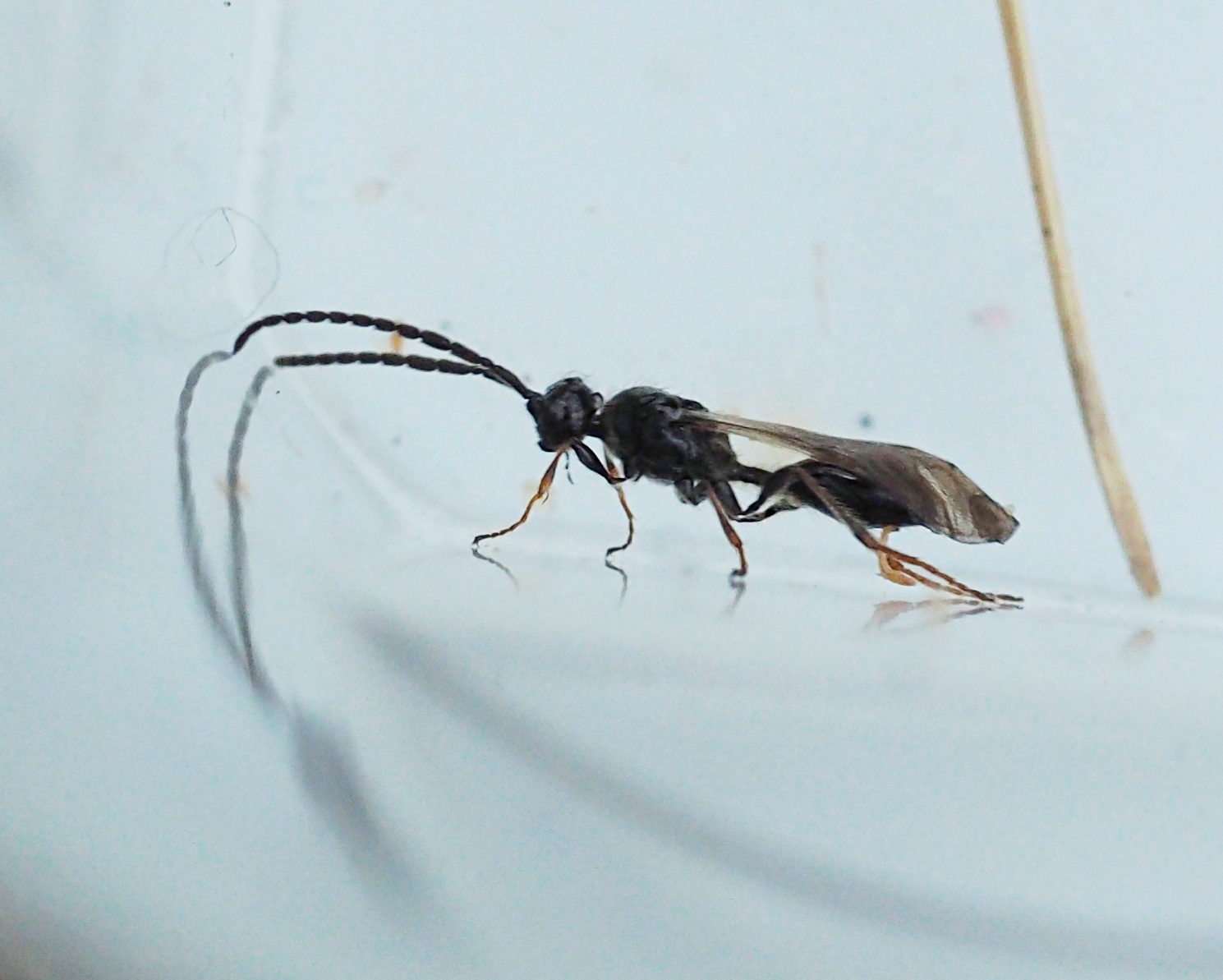
The other was also a Parasitica but a Diapriidae. Fortunately the good people on the international Hymenopterists Forum FB Group came to the rescue, put me in the correct family and genus and then DN suggested a species pair. I went to the key and after a bit of a fight, not least because there is a mistake in the key (how do you get to couplet 7? At 5 it should be 6 or 7 not 6 or 9.) I decided on Spilomicrus annulicornis which DN subsequently and kindly confirmed.


Careful viewing of the antenna is key to identification.

Spilomicrus annulicornis, male, just under 5mm.

I found this in the sample because I pulled out two beetle pupal cases, perhaps of Quedius or Philonthus and it emerged from these where it had presumably been sheltering. Spilomicrus, unlike most Diapriidae are parasitoids of beetles and not flies.

Spilomicrus annulicornis and pupal cases.

I'm currently working on another hymenopteran, a sawfly. A combination approach of using the keys and looking at images has got me to Euura vaga, which would also be new to the county. I'm awaiting expert opinion on my rather flaky ID technique.


Putative Euura vaga.

Not too many beetles at the moment, but I did attempt this Atomaria which I think is Atomaria rubida, well it keys there ok. They are very small, 1.6mm, and tricky, but Mike Hackston's key should have done the trick.


Atomaria rubida.


An Otter was hunting eels again in The Shunan, I think a different one, a dog. It looked larger and the geese were frightened of it, unlike last time. I also came across these Otter tracks on Skaill Bay beach.


Otter tracks, see how its tail drags on the sand.


Saturday, 22 April 2023

Orkney Vole 2 (and #patchgold).

So the BIG NEWS is Canada Goose on The Shunan yesterday. This is the first record for the 1km patch, although I have had a hybrid with a Greylag in the past. I have one prior record for the larger 3km patch, if I recall correctly, a small flock flew through.

Canada Goose.

Sadly it is a standard, large, plastic one (feral population) and not a more interesting small, trans-Atlantic, migrant one.

More work on Orkney Vole resulted in these stills (not the best) and a very nice video.


Orkney Vole.

The camera trap does not take very hi-res images. I'm wondering about trying the Olympus TG4 on this job and just setting it to take a load of images. The voles are being fed so they keep coming back to the spot. Alternatively I could lie out there with the EM5 (for hours).

However, I was pretty chuffed with this video...

Yesterday was a sad day as we had to have our old, and lovely pony put to sleep. Despite everything that we could do he was losing condition fast and it was just a matter of time before we had some awful crisis. We'd had him more than nine years and he was a family member.

Blue with younger daughter.

On a more cheery note a walk at The Links gave some nice photographic opportunities.


Eider.


Turnstone.