Thursday, 1 June 2023

Signs of a catastrophe, a visit to Sanday, more grey days.

My entomological FB and Twitter feeds are telling tales of woe for insects in England, in particular, small numbers being noted widely. Is this a weather related issue after last year or a climate trend? Here the problem is not with insects, although the cold weather has curtailed the mothing, but with sea birds, in particular Arctic Terns and the two skua species. 

On our trip to Sanday, 90 minutes each way by ferry, I saw very few Arctic Terns, one Bonxie and a possible Arctic Skua. There should be hundreds of Arctic Terns by now. The wee Arctic Tern colony at Skiba Geo has not established for the first time since we've lived here. Nine pairs were present initially, but they've left the site. I have seen a few skuas, three Arctic Skua visitations to the patch, and two Bonxie; about usual. But at Yesnaby very few, an Arctic and a couple of Bonxies the other day (and not one Arctic Tern). (Images posted in previous post, but I like them so hey-ho.)


Arctic Skua last week at Evie, there were three, Sandwich Tern pursued. Again, very, very few Arctic Terns at that site.

On the positive side, Gannets seems to be ok, the new colony at Marwick is continuing, Kittiwakes and Guillemots are at numbers that seem to equate to numbers from recent years, and there have been no impacts on Black-headed or Common Gulls from bird flu, as reported from England.

Whilst we try to move house we've resolved to try to do something "different" each week, or thereabouts. So last week we went to Sanday. I wanted to see if there was suitable habitat for Peleophila borealis, the loch shore ground beetle; there isn't. And also try to record some beetles for that island.

The lochs on Sanday all have sandy margins and shores, so I decided that was reason enough for a lack of the beetle. However, I searched the dunes near Start and came up with the weevil Otiorhynchus atroapterus which is NFM and I think new for Sanday.

Otiorhynchus atroapterus, similar to O. arcticus, but usually a tad larger and with fine hair-like scales.

Also present were Nebria brevicollis, I continue not to find N. salina, and a couple of nice Staphys, Lathrobium fulvipenne and a Gyrohypnus, probably angustatus, but it was a female so no dissection.

After lunch at 59 Degrees (recommended), we headed to Sands of Ayre where I discovered a carabid NFM and for Sanday, Calathus mollis.


Calathus mollis.

The other highlights from the Sanday visit were the impressive numbers of Turnstone and Sanderling, and a couple of smart, summer plumage, Great Northerns, which I failed to photograph.


Sanderlings, Turnstone and Start Point.

We didn't cross to Start as it was an incoming tide. There were probably 300+ Turnstone and 100+ Sanderling just near the narrows. Also of interest, ground nesting Fulmars.

Fulmar nesting on the ground.

Other events this week have included, managing to capture more Ichneumonoidea, these are awaiting identification; managing to identify a sawfly, and passing on my backlog for expert attentions (thanks JS)!


Dolerus gonager, er no not identifiable from these images.

Required a bit more attention.


Saw sheath, the crucial bit on Dolerus.

Saw of female.

I was a bit gung-ho and went for extracting the saw rather too promptly, with Dolerus it is the saw sheath that is important for most species. Fortunately I had already taken photos that showed the required bits for ID. (Thanks again JS for confirming the ID.)

A new hoverfly for Orkney is not an everyday event. I was asked to look at a couple of specimens from nearby Finstown. Cheilosia are awkward. The first turned out to be C. fraterna which I've identified previously, from Finstown. The other animal proved to be a different species. I spent a whole day on these, and in the end got to Cheilosia latifrons which was subsequently confirmed from my photos by RM at the hoverfly national scheme, chuffed!

Cheilosia latifrons (the full set of images for ID can be found on the Hoverfly UK FB pages).

I've made a few trips to Yesnaby, on two occasions to help others to see its specialities but a visit there is rarely wasted.

During two visits we found Chrysolina intermedia and have definitely proven that the adults feed on Plantago maritima, backing up the observations of the Species on the Edge team and MG who has carried out a large number of important observations of this species. More info, and images, on the Orkney Insects Open Forum FB pages. 

Chrysolina intermedia on Plantago maritima.

MG subsequently managed to find larvae feeding in the Plantago, a first for any of us interested in these fascinating, and ultra rare, beetles.

The usual suspects were also on show at Yesnaby, but a surprise was found under a stone.

Cantharis rufa (darwiniana) (Thanks MG.).

I've only once seen a large Catharid on Orkney previously, also at Yesnaby, and I managed to make a pig's ear of the photo and didn't take the specimen. Lesson learned, this went in a pot.

I photographed it (techy photos on UK Beetles FB site), tried two different keys and Mark Gurney's excellent picture guide, but I wasn't convinced of the outcomes. Fortunately, MG was directed to my posts and came up with the answer and explanation. Only two previous Orkney records, so a nice one, and also NFM.

Lastly, the pheromone traps have still been producing the occasional gem. Two Dolerus gonager, the occasional Ichneumonoidea (although of late my backlog to identify have come from windows in the house) and this excellent tiny beetle (slightly rubbish images).


Salpingus planirostris.

Second county record I think.

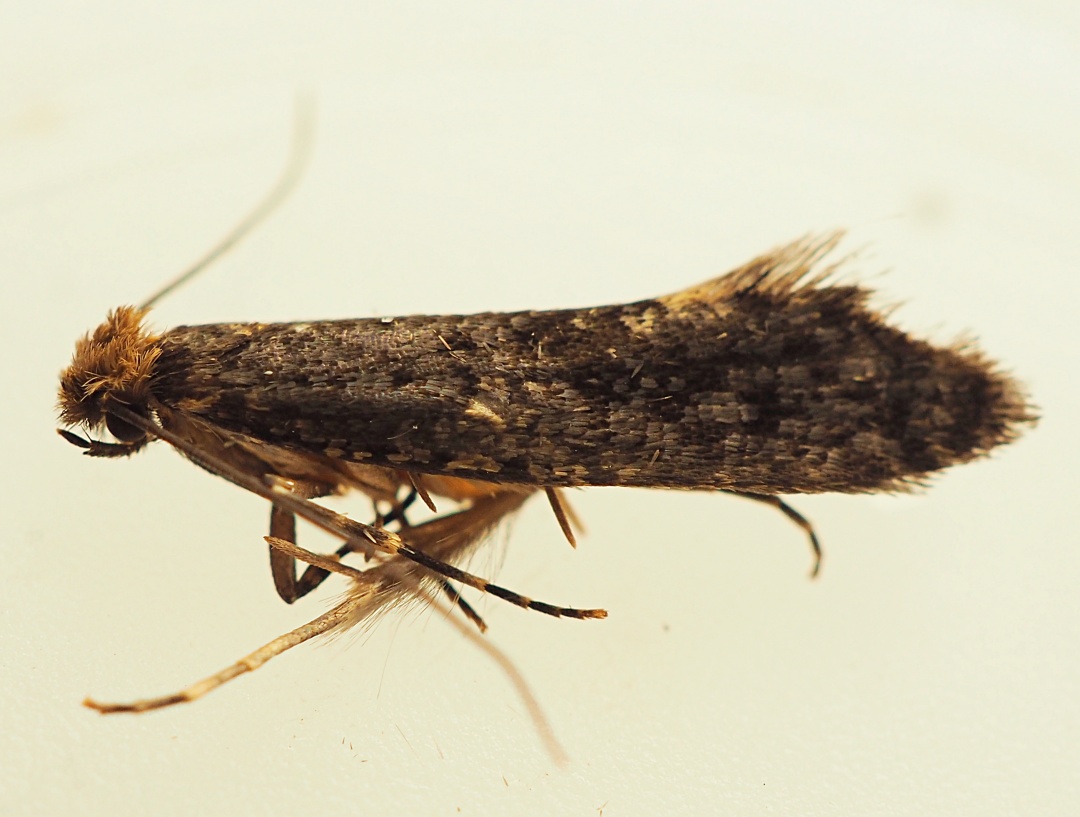
Moth trapping by light has taken a back seat it's been so cold, grey for days and days with a sharp wind in the north. The haul (ha-ha) on Monday night was three Hebrew Character, this pug which I think (SS?) is Grey Pug and a micro which escaped. That was with running two traps.

Grey Pug, I think. The wee pale and darker squares on the hind margin of the wing...?

Lastly, really... a trip to Birsay and I was grumpy, it was bloody cold and grey and the accompaniers were f***-a***ing about on the beach. I started turning stones over and was pleasantly surprised. Six of the tiger of the shore... Broscus cephalotes.

Broscus cephalotes.

Tuesday, 23 May 2023

...but know when to throw in the towel.

I've stopped trying to identify the Campopleginae that I spent so long on. Happily a more knowledgeable and experienced entomologist has taken them on (thank you AG). I've stopped because getting to a more definite identification requires experience with the family, which I don't have. The literature available can no longer guide me to an answer. But, I learned so much of the terminology and morphology that I could move on quickly to that next specimen and identify it.


Agrypon flaveolatum, male.

The shape is typical of the Anomaloninae. And this common species keys out relatively easily.

The photography using the EM5-11, 30mm macro and holding it to the microscope eyepiece is improving. Open the aperture, f3.5 is good; get enough light and as fast a shutter speed as you can; avoid noise by keeping the iso to around 500 or so. Using ethyl acetate to subdue or kill specimens is far better than using the freezer as the ethyl acetate keeps them supple. Ichneumons are pretty resilient so they can be stunned for quite long periods using this chemical (thanks for the tip MS). However, ethyl acetate dissolves some plastics so use glass jars. Best to set up a larger, wide necked, shallow jar with absorbent material in the bottom, a lid on top of that and then a small specimen pot to sit on the lid.

Face, clypeus, palps of the A. flaveolatum.

Propodeum (apical end of the thorax dorsally), showing the typical "disorganised" carinae of this species.

Teeth and front coxae, the coxae lack carinae (ridges).

The images are manipulated in Photoscape X which is free software. I guess I could probably do better with Adobe but it's expensive stuff.

Anyway, the learning on the Campopleginae was usefully employed. I've got three more animals to address now, all from the garden.

Ichneumon sp I think, possibly suspiciosus but I need to compare the tarsi with my images of stramentarsus. This one seems to lack a white spot on T4.

The moth trapping has not produced anything of interest, but I did find this Monopis laevigella on the garage floor.

Monopis laevigella.

A wander up on the moor located the usual Green Dock Beetles and also Heather Beetle which I haven't seen for a while.


Gastrophysa viridula, female top, male above.

Lochmeae suturalis.

I sometimes comment and offer identifications in Facebook Groups, particularly in our local entomological group. An interesting looking beetle popped up the other day, something unfamiliar to me. I quickly looked at my usual sources, noticed that nationally a particular species was being found and offered an ID. Fortunately I did hedge my bets a bit, because I got it wrong. I wasn't far away but a bit more attention to detail would have helped; less haste, more speed. I should have learned my lesson the previous day when I did exactly the same with an unfamiliar moth. No harm done, useful discussions came out of these two occasions, but with a bit more care and thought I'd have IDed these correctly. With any identification the answer and certainty lies in the detail. (Ok jizz IDs don't, but that doesn't really work with photographs.)

Bird flu still seems to be around. Following on from the previously mentioned Herring Gull and Cormorant there was a dead large gull near Skaill, a report of a dead Bonxie on Westray, and a drake Eider in the middle of a field near Birsay. Unusual behaviour seems to be an indicator of bird flu. On the plus side the Gannets at Marwick seem to be ok with the colony continuing to establish. However, there are not many Bonxies around. On a more cheerful note we found this pair of Eider nesting at Yesnaby.


Eider, drake top two, duck on nest I think, bottom.

The Spring Squill was flowering in carpets and there were hundreds of Scottish Primrose. We paid homage to the Oyster Plant.

Scottish Primrose.

Spring Squill in front of The Castle.

Spring Squill.


Oyster Plant.

The swell was surprisingly high.

Today we went to Evie. There were a few Arctic Terns, a Sandwich Tern and three dark phase Arctic Skuas.


Arctic Skua and Sandwich Tern.

The target species were somewhat less spectacular. A couple of fungi that infest Viola sp.

Urocystis violae on Dog Violet.

Puccinea violae on Dog Violet.

Urocystis violae is found only here and at one other site in Orkney. The photo of Puccinea violae was taken at Yesnaby where I'd found it the previous day, but it was located at Evie also. Gripping!

There are some other Hymenopterans but I'll save them for another day, phew!

Louise went to pick rhubarb for pudding but had to abandon the mission when she found the Blackbirds were nesting in the crown of the plant.

Thursday, 18 May 2023

Perseverance...

 ... is a good quality. Carol Dweck's work played a large part in my professional life and in our parenting. We were discussing it's implications the other day in a reflective kind of a way. If you want to know more the book is Mindset by Carol S. Dweck, there are lots of interpretations of Carol's work but I was introduced to her work by Barrie Hymer, emeritus professor of psychology in education at Cumbria University https://barryhymer.wordpress.com/. I went to an in-service day, probably the most important in-service training of my professional life; well more than that as Louise and I applied the ideas to our parenting, which we think has turned out pretty well: other opinions my exist...... (Ha, ha, ha!)

I'm applying growth mindset practice to my ongoing struggles to identify Hymenoptera, particularly the pesky wee Campopleginae which have turned up in the pheromone traps. I'm not sure how many hours I've spent on these animals now but it is getting on for a whole day and night I suspect, not in one go I hasten to add. 

The advantage of this perseverance is that I am learning the morphology and terminology related to Hymenoptera, and particularly the Ichneumonoidea as I go, and it is sticking, a good bit. Much help is being enlisted online, again thank you to those who are helping, it is much appreciated.

Anyway, here's a pile of photographs of the male Campopleginae which were proposed as Tranosemella praerogator. It was a big help getting steers to this point.

I've run the males through the Transosemella key and they don't go, the propodem carinae look about right but the leg colours, specifically the coxae, trochanters and trochantellas are the wrong colour. Information received (thanks MS) suggests that in the NHM there are possibly three UK species additional to the key, so Tranosemella sp is where we get to. Now to look more carefully at the female....


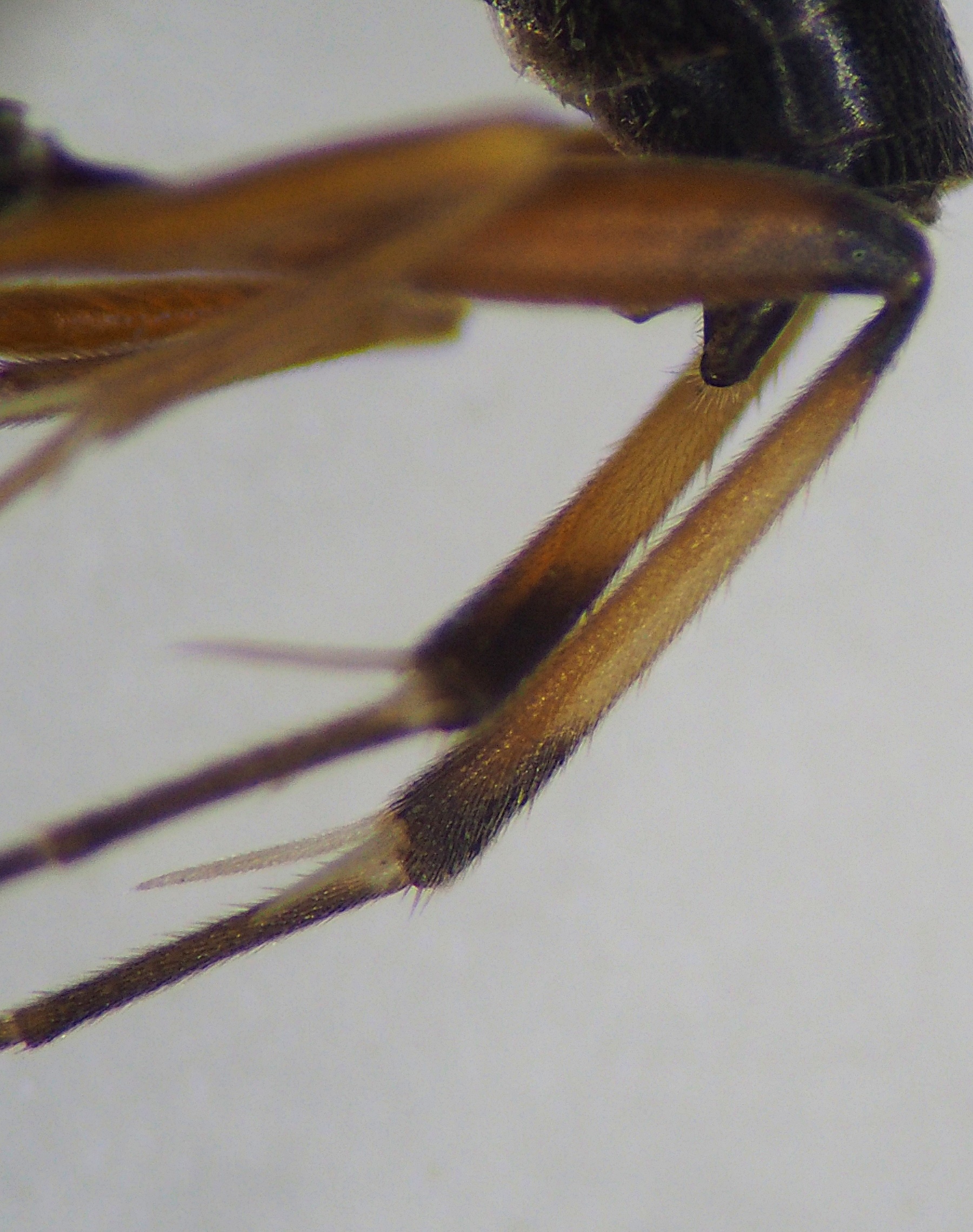
Tranosemella sp male legs.

Male 1 head and mesoscutum dorsally.


Propodeum male 2 showing the carinae (raised ridges).

Teath and edge of clypeus.

Slightly concave clypeus, scape is yellow not predominantly black, and there seems to me a subtle difference in the eye margin compared to the images of the reference specimen.

Male 1

Male 3

Tergites latero-dorsally.

Hind tibia and spurs.

Left wings, male 3.

I'll have a detailed look at the female, maybe later today or in a day or so. Although that looks superficially similar it has been suggested that it may be a Phobocampe species.

The pheromone traps produced another Ichneumonoidea today.


Ichneumonoidea 18th May, pheromone trap.

So as President Jed Bartlett would have asked, but this above means I know already, "What's next?"