A very low tide at somewhere we walk fairly often, mooching about on the rocks, looking at life in rock pools. I looked at my feet and I was pretty much standing on these.
 |
Not plant fossils.
|
I'm very ignorant about such things, geology and paleontology are a mystery to me. However, KF at Stromness Museum knows a thing or two about such stuff so I mailed her. And back came - "I think you have found examples of where the seaweed Desmerestia has
burned the algae (and lichens) off the stones with its sulphuric acid. You see it at
Birsay quite often. There is a science festival talk on seaweed from a
few years back with Andrew Want, Rebecca
Marr etc where they explained it and that's where I learned about it."
This made a bit more sense to me as I couldn't understand how the "fossils" showed through the lichen Verrucaria maura (Tar Lichen, the black stuff in the images). If you google there are various papers in Research Gate. Interesting and quite beautiful as well.
What else this week? Well I went twitching. Something I do about once a year. Was it a rare passerine on Papay, or seabirds steaming past NRon? Nope it was this...
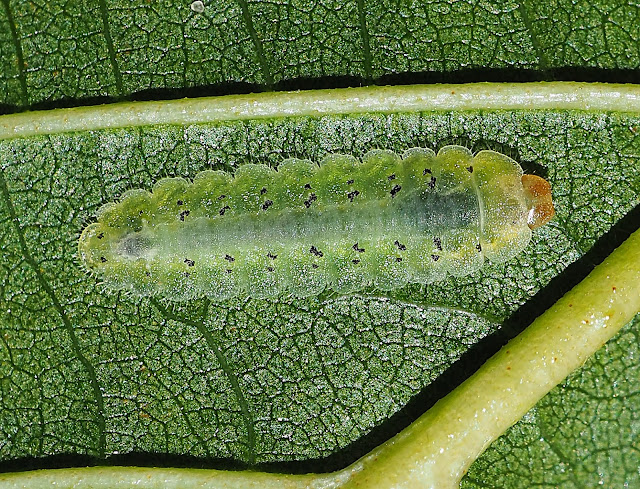 |
Platycampus luridiventris, a sawfly, and a larva at that.
|
A smart wee beastie, quite different from most other sawfly larvae and well worth the drive down to Westshore, Burray where it was in BH's garden. The usual hospitality was enjoyed and Louise and I had a tour of the garden, thanks LH.
We also saw another sawfly, Hemichroa crocea, which I'm not sure I've seen previously. It's one of the species where lots of the larvae aggregate. They do this weird synchonised waving, I presume as a defense mechanism.
 |
Hemichroa crocea, also on Alnus glutinosa - not the best images, wind and lack of light, my excuse.
|
I then had a poke around the roses, which were clearly being, or had been, mauled by something. Eventually, on a nearby Mullein (Verbascum sp) I found this.
 |
Pachyprotasis rapae, which I have photographed here before as an adult (if you search the blog - box top left - you'll find the pictures).
|
By being a tad too slow I missed photographing a male Vapourer which we noticed on the living room window whilst drinking tea, darn! More on Vapourer in a bit.
Some days earlier I had visited another garden, going to fetch some moths to dissect. BR lives off grid up a long track, so the RAV4 was employed to make the journey. When we arrived, well, not quite at the house as BR was ringing Meadow Pipits and had his vehicle parked in the road, with a mist net set across the way too. Mist net furled we headed up to the house for tea and a chat. It wasn't a blizzard of Vapourer Moths but there were a lot of them, 30 or 40 flying everywhere. Unfortunately, I couldn't find a settled one to photograph.
The moths collected, a couple of Ears agg. and a Common Rustic agg.
 |
| Amphipoea lucens, Large Ear, with A.fucosa the spines on the clasper should overlap. However, whether these two are really separate species is questioned. A.fucosa is associated with sand dune and salt marsh habitats, A lucens is more catholic in its habitat preferences. |
|
 |
Second Amphipoea lucens.
|
I nearly made a mistake with the rustic though. As I almost presumed it was Mesapomea secalis, that's what I was expecting. Fortunately, I dissected out the cornutus and then realised on looking at images on the websites that I'd got a male M. didyma. So of seven or eight dissections I've found two M. didyma, it's clearly much more common than was thought previously.
 |
| Cornutus |
 |
Mesapomea didyma.
|
On the bird front, the first signs of autumn are with us. This week Grey Wagtail has flown through the garden a couple of times and a female Merlin shot by yesterday afternoon. The Whooper Swan chicks are now nearly as large as their parents. Teal and Mallard have reappeared on The Shunan in numbers with twenties, approaching thirties of each.
 |
Shag with sandeel, Evie.
|
A few autumn moths have put in an appearance, nothing spectacular, just the standard fare of wainscots, Silver Y and Pink-barred Sallow.
 |
Double-striped Pug, a nice surprise.
|
 |
Large Wainscot.
|
 |
Small Wainscot.
|
The most exciting moth of the week escaped before I could photograph it, just as I reached for the camera, it flew over the house and away. I think it was Marbled Beauty, but it was gone.
My hunt for additional Calliphoridae species proved successful with a small bluebottle being identified as Protophormia terraenovae. It keyed out pretty well, which was handy.
 |
Pre-archostichal bristles absent.
|
 |
Calypters dark brown, upper one with black hairs.
|
 |
| Face. |
 |
Hypopleural bristles present.
|
 |
Protophormia terraenovae, face doesn't extend forwards, body and head 9.7mm, wing 8.4mm.
|
First catch your Calliphorid, not especially easy. I've found sneaking up on them with a sample tube to be the best technique.