Thursday, 9 November 2023

Weather - spaced out!

 Nice aurora on the evening of 4th November. I pottered out and took a few pix after younger daughter, who lives south, had alerted us to the lights.


Our house with the aurora behind.

And again...

Aurora and shooting star.

There is a bit of an issue with dust on the camera sensor with night photography; irritating, the images take a lot of cleaning with my software (Photoscape X, free). And i do clean the sensors, but it's tricky.

These images are not much meddled with in the software though, other than a bit of cleaning, and some cropping. I like to try and keep them as much as possible as they came out of the camera. The aurora doesn't really look that green to the eye, the camera exaggerates the colour. The aurora just looks as if it isn't as dark as it ought to be for the time of night, and then the brightness moves about. 

The next night things went a bit bonkers. The Weatherman mentioned more aurora in his report, we checked the app and yes it was a red alert.

This is probably the second brightest aurora I've seen since we've lived here, it was all around us, not just to the north, and it was very active at times, flashing and moving. Some colours we certainly visible to the eye. Again, with the photos I've tried only to clean and manage the images a little, not go for massive effect.

Aurora over Dounby.

Our house with aurora to the north.

Aurora to the east, our neighbour's trees, the rookery.

And again...

Aurora to the west.

The weather itself has been pretty odd, no wind, just still for days. Today was the first day for ages with any kind of breeze, and that died away for the afternoon.

Still water and lots of reflections led to a few attempts at photographing the landscape.

A moorland pool, Swannay Loch and the Hoy Hills.

Swannay Loch.

The view north towards Eynehallow and Evie.

We'd walked to the trig point at Costa. I'd never been there before, it is a slightly awkward place to get to with limited parking and a bit of a walk along the road to get to the footpath.


Louise walking back to the trig.


Moorland pools and the Hoy Hills.

 The day before we'd walked up to the Birsay Moor trig point. Another place which is slightly awkward to access. Jack Snipe, Snipe, Raven, Reed Bunting and male Hen Harrier were the only birds.

 Further expeditions were made. An evening outing to check on the Barn Owl drew a blank for that but I did relocate the Great White Egret, back at its original location, seen flying in to roost.

Loch of Wasdale.

A trip to Dounby by bike to the post office involved a diversion to Loch of Sabiston, just checking for egrets, but there were none. Just two flightly Waxwings in Dounby village.

Broken tractor, Dounby.

The light traps have produced just a few Mottled Umber. Unless I get a very warm evening now I probably won't use the light traps now for a while; unless we head south of course.


Mottled Umbers and slightly sinister thoracic face.

The only other beast of special interest was a Staphylinid beetle, I found this in leaf letter whilst looking for moth pupae. Always a slightly tricky ID but this is the species of this genus  these generally turn out to be here.

Lesteva sicula, 3.5mm, a small beastie.

The pits on the elytra, how large, close and deep they are are needed for ID, and can only be seen properly if the elytra is spread or detached. The short antennae and shape of the pre-apical segments are also very useful for identification.

Sunday, 5 November 2023

Listing

Pan-lists are going up on Bubo and this is motivating me to actually sort out my lists of things other than birds, which I've never done. Indeed the bird lists themselves are languishing somewhat with only the UK self-found list now up-to-date (and that requires a +1 to add Pterodroma feae agg which Bubo won't have for some reason).

For an explanation of pan-listing head here - https://psl.brc.ac.uk/about and there is an active Facebook Group, here - https://www.facebook.com/groups/1550187855270648

The Bubo Listing pages can be found here - https://bubo.org/view-all-lists.html?showlists=7546,PSL  The totals on the PSL lists on Bubo are currently quite low because only a few species groups have been added, they are currently being added at roughly a group of species every couple of days (I'm already a bit overwhelmed).

I don't have a photo of my "blocker", Coypu is on my list, now extinct in the UK after an effective eradication programme in which I took part as a volunteer at Minsmere, in Bert's day. I argued successfully for the Swona Cattle (Bos taurus) to be added, established since 1974 as a feral species, but failed with Feral Cat (Felix catus). I guess my other blocker is Wild Cat (Felix sylvestris) one glimpse of the thick-tailed one, many years ago,out on the hill; again no pictures. Orkney Vole (Microtus arvalis orcadensis) is also a bit of a blocker.

Orkney Vole, Microtus arvalis orcadensis

Can be observed in our garden with a bit of bird food and apple baiting and some patience. I will be sad to leave them when we move they are a very beautiful little mammal.

Birding has dominated my time. I've identified very few insects in the last week, other than a few pictures online. The rain over the next day or so may change that. Waxwing has been bird of the week with them turning up everywhere, other than our garden. My attempt to string one on call early on has been self-rejected, I think it was probably a Dunnock. In the end we went to see them in Stromness and re-aquainted myself with the call, softer than I remembered. So when I was hunting for things on the Heddle Rd in Finstown yesterday I was certain when I heard the call twice. Eventually they arrived in the garden, but briefly, whilst we were cleaning the house today. I'd just been outside for a good while doing the windows, before, and then Louise saw two sitting in the front garden Budleja, and fortunately, I glimpsed them before they flew off; studiously ignoring the many apples on sticks around the garden.

Stromness Waxwing.

We've had at least one Blackcap for a few days stuffing itself with apples, indeed it's hard to believe one small bird could eat quite so much apple.


Blackcap.

But star of the garden show was a fabulous Great Spotted Woodpecker that spent half an hour around the feeders. A hasty refuel before heading off away again.


Great Spotted Woodpecker, subspecies major, a 1cy female.


The trip to see the Waxwings in Stromness was followed by a walk on nearby Warbeth Beach, where there were three Grey Plovers.

One of the three Grey Plover, with an Oystercatcher and Common Gull.

On the moth front I've been collecting Ash keys. Most of the Ash in Orkney doesn't seem to fruit, at least not the trees I visit. However, on the walk from Loch of Wasdale to Binscarth as you approach Binscarth the path is lined with some lovely stunted, wind-formed Ash and at least one of these has fruits. Close observation of the keys show that some of these have a hole in them. There is a moth that does this, a rather small one, called Pseudargynotoza conwagana, long name. It's a micro, quite an attractive one, with just one Orkney record. I dissected a few Ash keys with holes in, but the hole is an exit hole, all I found was frass. However, Micro-Moth Field Tips suggests putting keys (without holes) in a jar, labelled of course, and seeing what happens. I've been checking the jar everyday for a week, and today, there is a tiny caterpillar. I'll photograph that tomorrow, here's an Ash key with an exit hole anyway.

Ash key with exit hole, hopefully made by Pseudargynotoza cowagana.


Pseudargynotoza cowagana larva
 

I went to Finstown to try to tick a fish, a Saury, Cololabis adocetus, unsurprisingly I failed; the lack of fishing gear might have had something to do with that. However I did get fab views of a Red-throated Diver, perhaps hunting said fish.

Red-throated Diver.

I then looked at Binscarth, two Waxwings by the shop. And headed up the Heddle Rd - Bullfinch, Coal Tits x2 at least, Waxwing again and two Swallows, my first November Swallows in the county. The pics of all these are rubbish so I won't bother.

Evie Beach.


Wednesday, 25 October 2023

2+2=1

 Two moth traps, out for two nights, one moth caught.

Angle Shades.

It was worth a try, down in the South of England it seems traps can barely avoid large numbers of rare migrant moths.

Other moth stuff has involved collecting more Gorse seed pods, a painful activity, and also Ash keys; looking for larvae.

I also had some dissections to carry out to sort out some identifications from specimens I received. The dissections proved very useful, two almost unidentifiable specimens of Noctuids mooted as rarities were proven to be more common species. However, Marbled Coronet and Lobesia littoralis were both proven. (Thanks again to SS for his help.)

Marbled Coronet.

Perhaps not my best work, but good enough.

Aedaegus.

Lobesia littoralis.

Again, maybe not my best work but...

I carried out some more Agonopterix dissections, all four proved again to be A. heracliana. 

On the bird front a Ring Ouzel, just the third for the patch I think, performed nicely in the back garden.

Male Ring Ouzel, an adult.

The light was not the best on a very dreich day. ISO 10,000.

Some other bird photography was a little easier.

Blackbird; if I had to say I'd suggest 1cy male, but that could be wrong.

I had a trip out to check on the local Barn Owl again which afforded excellent and extended views. Hopefully folk will keep their distance as I think it has every chance of staying the winter.

Barn Owl.

We went for a stroll past Loch of Wasdale and into Binscarth Wood. No Coal Tit was found but it was a lovely walk on a beautiful, still West Mainland day.


Leaves, light, water.

Robin.

Back in the garden the Brambling flock got up to 14 and there have been over 100 Redwings through most days. Blackbirds and Robins have been noticeable migrants. An influx of Reed Buntings and two Stonechats, the first for a long time, were down by The Shunan where today there were six Common Redpoll and a large flock of 110 Fieldfares. 

Lunchtime today I got a phone call, "There's an egret near our house, in the field opposite the farm entrance." (Thanks IK.) Sure enough, and as suspected, this turned out to be the elusive Cattle Egret which allowed a brief photographic opportunity.


Cattle Egret.

But then, it was up and away. for no apparent reason

Thursday, 19 October 2023

Jags

I went for my Covid and Flu jags on Tuesday, so felt fairly rubbish on Wednesday and didn't do much, bit of a walk at Stromness, failed to find the Kingfisher, did find some Coleophora larvae and took a sample, promptly lost it whilst beginning the dissection, it vapourised, somehow; darn!

Today has been spent in front of the computer trying to sort out some records. Cleaning my own data and raising questions about other records (huge thanks to SS for lots of assistance). The questions arise from information in the new Pyralid and Crambid Moths book. I've had the book for a few days now, and what a fabulous achievement it is. Apparently, it has taken the best part of 15 years from beginning writing it to publication and initial distribution. Well done to Mark P, Sean, Mark T and everyone else involved. If you're interested in moths don't hesitate, just get a copy - https://www.atroposbooks.co.uk/pyralid-and-crambid-moths-of-britain-and-ireland - still with £15 off.

Ok, so I used to go birding with Sean quite a bit, and I've got a great story that he won't like about crashing his (Dad's?) car on the way to Dunge one time, and the very cool woman whose car he'd just back-ended, "Do you always stop like that?" (Sorry SC.)

The questions raised are around a couple of species of Eudonia, if you have the book you can see question marks over Orkney for E. lineola and E. alpina. I've just scrubbed my two E. alpina records having gone back to my photos (all kept by date).

Eudonia angustea.

Eudonia alpina occurs early, from May to July, and not into August, and is larger, usually, than E. angustea. I haven't found Sterling and Parsons that helpful for this species, comparing photos with the illustrations, although to be fair if I'd read the text more carefully... (and listened to MP) I might have done better. Anyway, remedied now.

I fared a tad better with the Cattle Egret than with the Kingfisher. We had another look for it and got distant but acceptable views.

Cattle Egret, 2nd Orkney record, thanks to MT for relocating it.

I also managed to see my first definite Orkney Barn Owl, which was in the area of where I've had a few possibles from the car, at night, over the years. It was a very white one, so likely from Scotland and not Europe.

Up to seven Brambling have been in the garden with three Chaffinch, a couple of Greenfinch and six Goldfinch, so perhaps our variety of feeding birds is returning, the last few months it's been very thin.

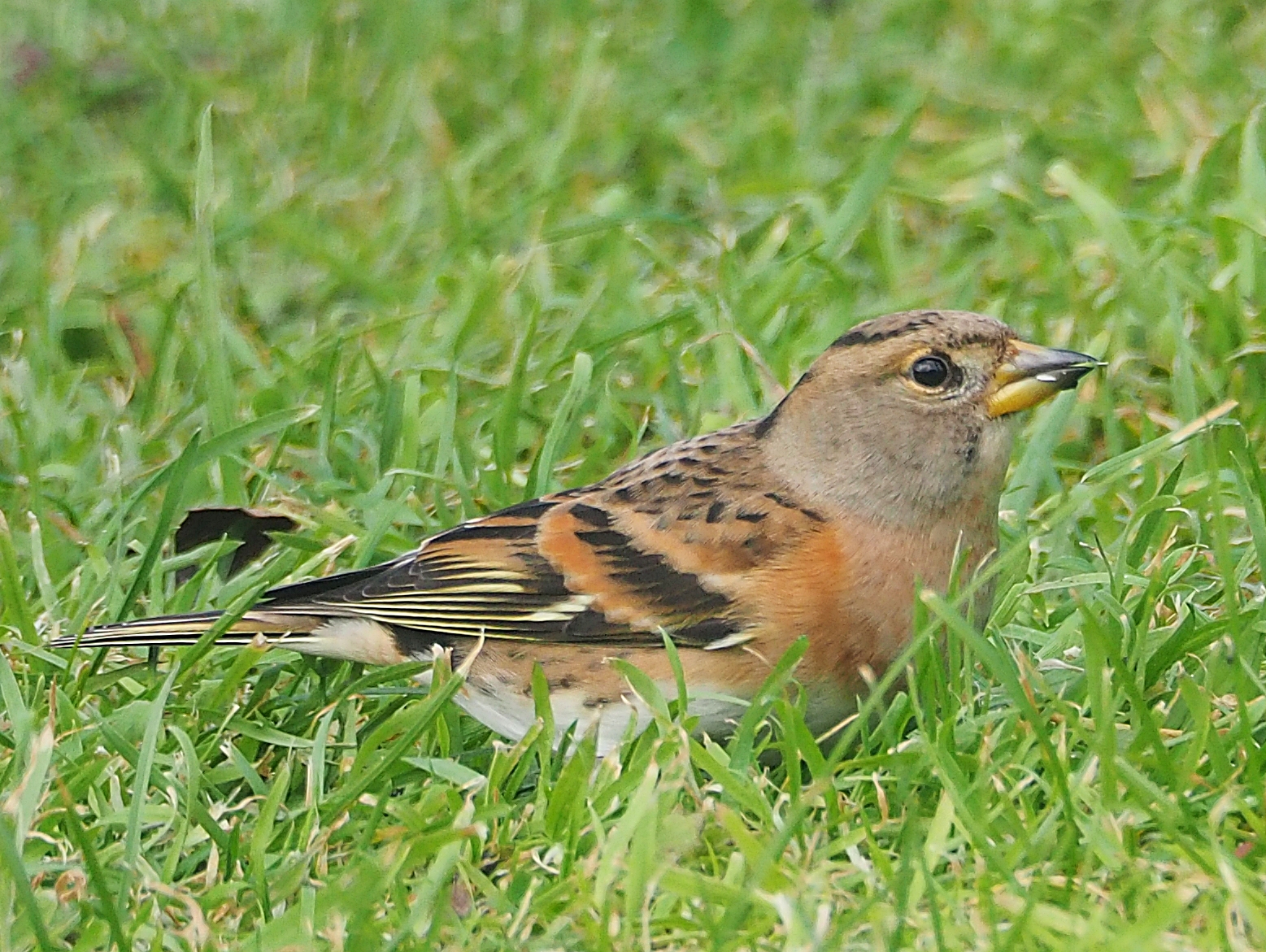
Brambling, male.

Brambling, female.

Chaffinch, male.

Goldfinch.

On the birding front, a bit of a disaster, I took the scope out of my rucksack to use it the other day and it was a bit knackered.

Nikon ED 50 Fieldscope, a bit unwell.

It got that dent a few years back, I guess that had compromised the airtightness of it. I'd been out in the rain and hadn't opened the sack, so humidity had got in I suppose. Fortunately I still have the very old but faithful Zeiss, but it's not nearly as easy to carry as the Nikon. It will shortly be on the road, to the Nikon Repair Service.

Currently, there are apples on sticks front and back, and a feasible Waxwing was heard going over the other afternoon. It's been a while since we've had them in the garden.

I was sent a few moths to dissect to confirm the ID. I chickened out with an Elasticha, rather rare and small, so I passed that on to more expert hands (thanks MY). However, I did tackle a Depressaria which turned out to be D. sordiditella. Second county record I think so a nice one.


Depressaria sordiditella, male. (Thanks to MY for confirming.)

Dissection of a pug was interesting. Their genitalia are pretty much as hard to unpick as are the whole moths. However, I got it to Common Pug in the end.

The moth traps also did some business with a couple of Mottled Umber, two more Red-line Quaker and a late Rosy Rustic.


Mottled Umber, males.

Red-line Quaker again, I'm having a record year for those.

Mottled Umber is approaching favourite moth status, perhaps something to do with that weird face you can see on the thorax.

It is really blowing tonight, it's doing that thumping thing it does in the gusts and it's due to continue all night and into tomorrow with heavy rain as the supporting cast.  Coming from the east, so maybe there'll be some interesting birds in its wake. There might be some interesting moths too, the traps will be out as soon as possible after it has done with its weather.

Hoy High (it's actually on Graemsay) from the Stromness shore.