Monday, 4 September 2023

Arty farty.

There are a lot of ultra macro images on the internet these days, usually close ups of insect "faces". They are amazing images. Some, but not all, take a lot of time to produce, stacked images (lots of images combined to obtain huge depth of field), although many Olympus cameras will stack images internally, and can be set up with a pile of options. My second hand EM5s have this capability, if a tad more limited than say an OM1. The images below are single shots though, two were taken at night with the kit flash gun. Colours of the insect world.

Grey Dagger, caterpillar.

Nicrophorus investigator, and passenger.

The Herald.

The colours are natural, and it's the lower two images taken with flash at night, the Grey Dagger was a daytime image, the glossy reflection a natural element of the caterpillar's epidermis.

I might do a bit more of this in the future as I like the images; patterns, colours and textures of the natural world.

A couple of moth dissections recently have unravelled species aggregates. The Ear sp (Amphipoea) from VC90, Angus, proved to be Crinan Ear, Amphipoea crinanensis.


Crinan Ear (Amphipoea crinanensis), male.

 Of the four species this is the easiest to figure out from a dissection.

Not quite such an easy dissection, or to figure out was Agonopterix heracliana. Theoretically I've seen Agonopterix ciliella here, I dissected the hind wing out in the past and it showed the four or five dark lines in the cilia. However, there is some contention about that criteria not being reliable. The dissection of the genitalia is reasonably clear. But, in addition, this moth did not show more than a line or two in the hind wing cilia.

Agonopterix heracliana.

Male genitalia Agonopterix heracliana.

Agonopterix heracliana, stacked image, one, maybe two dark lines in the cilia of the hind wing.

Here's the Grey Dagger cat in all its glory, something a bit more straightforward to identify.

Enjoying the roses on the front of the house.

Birding has been quiet until yesterday and today. We went out to Yesnaby yesterday, the weather was lovely and we were just ambling along, down to the wee burn and the bay, out the other side and an unmistakable bird flew right by us.


Great Spotted Woodpecker.

Well, that was unexpected.

Today, I looked at the What'sApp after I'd dug the tatties out and fettled the bed. Hmmm, Hoopoe at Stromness golf course. Louise and the hound were up for it, so off we went.

We couldn't find the bird initially, and we headed back up the hill towards the garden where it had been spending its afternoons. Three birders were up there already, and as we watched the bird flew straight towards us. Hidden behind a convenient stone dyke we had excellent views, Louise was impressed.


Hoopoe.

At the cafe enjoying a celebratory coffee and sandwich I amused myself baiting and photographing the House Spugs, they duly obliged.


House Sparrow, female, top; male, lower image.


We wandered back down to Warbeth beach for some clouds.

Monday, 28 August 2023

Angus

We had a few days South as we took younger daughter back to university and managed to find a place to stay in Glen Isla. The garden was small, but the owners gave permission for light trapping, and I just happened to have my wee Heath trap with a synergetic in the back of the car. I ran the light trap on three nights with mixed results but a few NFM and a few I see not very often, so a good result.

Picked off the outside of the trap the first night, Zeiraphera ratzeburgiana, Spruce Bud Moth, re-identification thanks MY, this is actually Epinotia tenerana, (Nut Bud Moth) NFM all the same.

Thanks to SS for identifying this for me, Mouse Moth, also NFM, I think, there are just a very few records for Orkney.

I caught a few Lesser Yellow Underwing, which are also very uncommon in Orkney.

Lesser Yellow Underwing, a very varied species, I caught one in Orkney the evening we returned, strikingly different.

Lesser Yellow Underwing, NFS, Harray, very like the illustration of "Hebrides specimen" in Townsend and Waring.

Not much else of note on the first night, although I had to consult again on a very different looking Square-spot Rustic, the Orkney ones are very consistent, and a good number caught in VC90 looked just the same, but this one looked quite different.

I expect them to look more like this...

Square-spot Rustics.

One of the reasons I'm not so keen on Noctuids is the large variations within species, you think you know one, but actually, you don't.

The predominant grass moth was Agriphila tristella (actually the only grass moth). Agriphila straminella is the main species in Orkney, pretty much finished for the year now.

Agriphila tristella.

other species caught were: Dark Arches, Antler, Smoky Wainscot, Large Yellow Underwing, Rosy Rustic, Burnished Brass, Small Square-spot and Common Carpet.

The following evening was a bit of a waste of time, just seven species, it was a cold night and the only thing new was a Cnephasia, which for some reason I didn't take to dissect, it looked like C. asseclana though, so that's most likely what it was.

However, the third night produced good conditions and a more varied selection and included some species I see very rarely and a nice NFM.


Black Rustic, two, a nice fresh one and a slightly worn one.

Bird-cherry Ermine.

Pine Carpet

Spruce Carpet.

Best capture though was this rather tatty Ear, Amphipoea agg

I took the specimen as it's one that should be identifiable with dissection.

Crinan Ear, Amphipoea crinanensis. The easiest of the four to ID on dissection, a male. NFM.

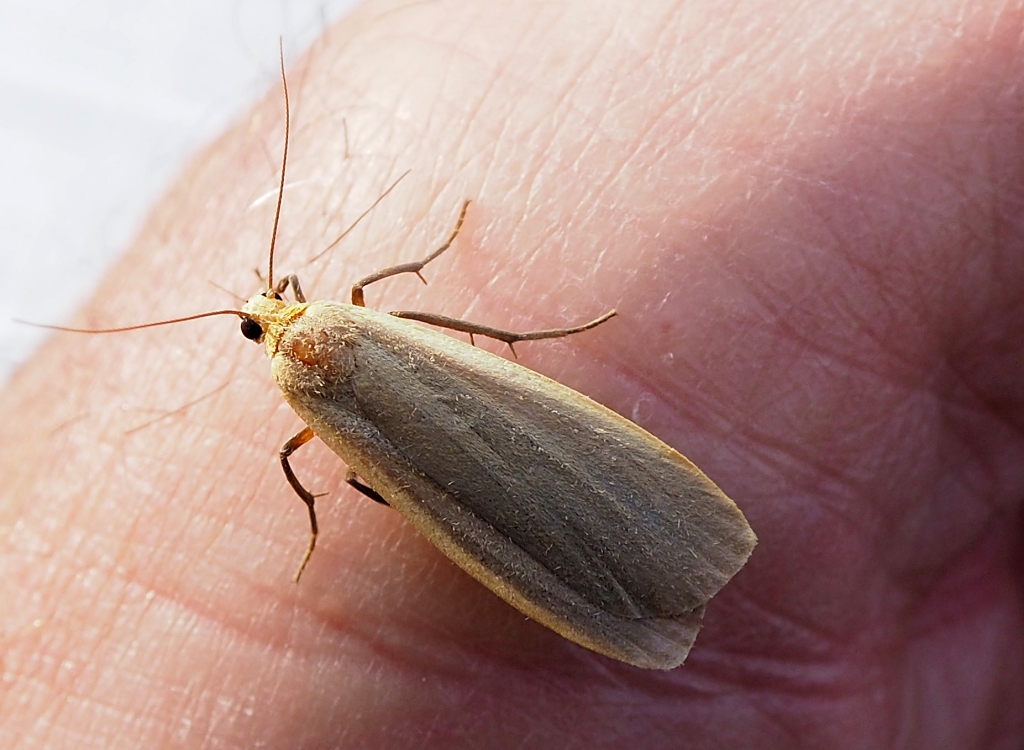
A Buff Footman was also a nice one, for some reason this is the species I tend to catch when I come south. The hind wing is grey.

Grey hind wing.

Buff Footman.

Additional species caught were:Autumnal Rustic, Common Marbled Carpet, Eudonia angustea, Eudonia pallida. 

There were various other things in the trap of course including four species of beetle, plenty of caddis, which I mostly chose to ignore, a collembola, a slug and a selection of craneflies which I also allowed to conveniently escape.

Nicrophorus investigator.

 However, I did find some caterpillars on the side of the cottage, shinning up the wall in the dark from their daytime hidy-hole in the Petunia pots. These took a bit of research but thanks to CH and SL and Lepiforum I found an excellent match with Red-necked Footman - NFM.


Red-necked Footman.

The other rather excellent insect from the trip was a bee, Louise found a moribund Bombus monticola on the day we went up Monamenach, and I subsequently saw two more, pretty sure I've not seen this species before, or at least not noticed it.


Bombus monticola.

Monamenach is apparently about the easiest Corbett as the starting point for the walk is quite high up. It is a pretty uninspiring tramp to the top, up a trackway for much of it, which the hound also managed. However, the panoramic views from the top are indeed worth the effort.

At the top.

Through the week I did my usual bird recording, Red Kite from the garden was nice. An Osprey, more kites and a likely, but just glimpsed, Gos were also enjoyed. A young Sparrowhawk terrorised the garden Blue Tits one morning, and then sat on the table a couple of feet from us. Loch of Lintrathen has a nice wetland and there were migrant waders, Greenshank, Green Sand, Ruff, and rather suprisingly a Knot. There were also plenty of Emerald Damselflies at this site.

Sparrowhawk, 1cy male I thought.

Lestes sponsa.

Monday, 21 August 2023

Joy

The Swallows that nest in the nearby farm buildings have fledged and are whizzing around the house and garden feeding on the wing. It's raining today and I'm watching from indoors as they tirelessly feed. But, in the sun, the last few days, with their calls continuous, it's hard not to think of them as joyful. They certainly bring us joy.


One of the Swallow families has taken to sitting on the house roof.

We've had so many t-shirt days, of course here that is a treat, but thinking a bit more about it, not such a good thing.

One of the other moth folk caught a Mompha but hadn't got the best pictures, fortunately they had kept it, so I drove over and fetched it. It turned out to be Mompha propinquella (thanks NV) which has only been recorded here a few times. In researching the record I found that the BC maps aren't quite as up-to-date as I thought they were, it seems that some of the Orkney data hasn't been integrated fully into the system.

Mompha propinquella.

I'd found a mine or two of the one Mompha that is found regularly here, M. raschkiella, which mines the leaves of Rosebay Willowherb, some weeks ago. But I've had a more careful look recently and found a lot more mines, some tenanted.


Mompha raschkiella, tenanted mine.

I've been missing my Shorties. Usually this species is a reliable early in the year visitor to the patch but not in 2023. It has taken until just this week for one, a very tatty adult, to decide to show itself. It then appeared on two days in a row. However,my usual early autumn Marsh Harrier arrived on schedule. Most notable though was probably the large number of Sand Martins down at Loch of Bosquoy, I estimated 300.

Sand Martins.

I managed a quick trip to Burray, partly on moth and hoverfly business, but there was an opportunity to have a meander with BH around his garden. Lucky we did, moth tick, Marsh Pug.


Marsh Pug, photos Barrie Hamill.

Marsh Pug, my not so good image.

I did take some decent pix of this Rhomboid Tortrix though.

Acleris rhombana.

A bit of a clear out of the fridge and I've a few IDs to catch up on. I did get around to this small beetle which I found on our Tansy.


Epuraea aestiva.

I think I may have had this species once before.

The Wild Angelica down at the Hawthorn Hedge has been covered in ichneumons. I was a bit overwhelmed, and not wanting to add to my fridge backlog just took photos. There's never any certainty that an identification is possible with photos of these wasps but, posting one of them, an identification was offered, and comparing my images with reliable ones online, the ID looks more correct than the identifier implied in his post (many thanks OV and ATM) - Endromopoda detrita.


Endromopoda detrita.

I've at least one more to post, but I do have a modern key so I'll have an attempt at the ID first. I did know that the above animal was a Pimplinae, I am making some progress with these.