Friday, 24 May 2024

Trees

We are living in a strikingly different landscape from the last fourteen or so years. From few trees to many. We did live amongst some trees in our part of Harray, in our garden there was a huge Sycamore, but most of the landscape was treeless.


Alder Alnus glutinosa

Douglas Fir Pseudotsuga menziesii I think.


(English) Elm, Ulmus (procera), Pretty sure this isn't Wych Elm but Elm ID is a tricky business.

These three trees are all pretty old, I'd guess that the Elm and the Alder are 300 years+. I must research the planting of Douglas Fir, a tree native to North America.

I used AI to identify the fir, and the app found that challenging to start with. I think it probably got it right but I need to check by taking some photos of the cones, which are distinctive I believe, and the foliage. I've been using ObsIdentify quite a bit, mostly with plants and moths. There have been so many moths that are unfamiliar that the AI tool is ideal for getting a possible ID and then checking with the books. It's much quicker to work this way and I've had so many unfamiliar species that identification has been a real challenge. I have no issue with using this tool, it saves a lot of time and I use the identifications as a guide, I know some folk think this is cheating, but I really don't see the point in spending a lot more time getting to the same result.

I've run a light trap four times. I have to be sharpish getting out of bed to turn it off as there are breeding Robins in the garden. Two nights have had a lot of moths and two have been not so productive. This is probably temperature related. Quite a few species I don't think I've seen before, and quite a few I've not seen for a while or have seen very infrequently over the last few years.

New (in no particular order): Scorched Wing, Least Black Arches, Grey Birch, Pale-shouldered Brocade, Clouded Silver, Great Prominent, Broom-tip, Scalloped Hazel (maybe I've recorded that before), Water Carpet, Peacock Moth, Pale Prominent and a possible Toadflax Pug. Another pug that might be Golden-rod.

Broom-tip

Clouded Silver

Great Prominent

Least Black Arches, which looks more like a micro-moth.

Pale-shouldered Brocade

Scorched Wing

   
Grey Birch

Pale Prominent

The Grey Birch is a good record I think. Unfortunately I messed up with the best species, a very likely Toadflax Pug. Fortunately I managed a photo or two through the tube, but when I attempted a "proper" photo, it took flight. I should have taken the specimen.

Toadflax Pug maybe. Identified as Foxglove Pug, thanks SS.

I should have learned by now with things like this; take the specimen. But... for various (unscientific) reasons I sometimes don't want to. Some discussion online about this ID but look here: https://britishlepidoptera.weebly.com/151-eupithecia-pulchellata-foxglove-pug.html

Other moths have included this showy threesome, left to right - Lesser Swallow Prominent, Herald, Buff-tip.

I've a couple of other interesting things from the pheromone traps, a putative Grapholite funebrana and another Tortrix to FUN which is one of the tricky Epiblema stricticana group (or similar). I'm told the G. funebrana will need dissecting to prove the ID, although I'm pretty comfortable with it. The Epiblema certainly needs dissecting. At least I've found the box with my microscope in it.

Many, many other new insects, I need to order a bee/wasp ID book. Here are a couple I've found.


Some sort of Nomad Bee, Marsham's Nomad, I think, Nomada marshamella.

And Orange tipped Mining Bee.


Orange-tipped Mining Bee, Andrena haemorrhoa.

Lots of new beetles, Necrodes littoralis and quite a few Melolontha, the difficulty is deciding which Melolontha. Both the Common Cockchafer Melolontha melolontha and the rare Melolontha hippocastani Northern Cockchafer are possible here, and perhaps about equally uncommon, theoretically. But which have I got?


There is a small forward facing spur on the third antennal segment, so I think these are the very rare Melolontha hippocastani Northern Cockchafer. I've sent images to be looked at by folk who will know better than I (now confirmed)    .

Males have seven "blades" to their antennae, whilst females have six. So the above images are of a male. Many thanks to MW and CU for confirming this identification.

There have been some other excellent beetles, and there are a few awaiting identification. 

Many of these about, some even living in burrows in the back garden.

Geotrupes stercorarius.

And this species has been commonly found in the in and around the light traps and once in a pheromone trap. Interestingly there are very few records for this VC (vice-county).

Necrodes littoralis.

Two more large beetles arrived on the outside of the kitchen window. Unfortunately the visit of Oiceoptoma thoracicum was brief, no pictures. But, Rhagium bifasciatum was a show off and posed very nicely.

Rhagium bifasciatum

There are quite a number of smaller beetles that I have to get the microscope into action for.

Lastly, and I've left out diptera, which have also been interesting, and caddis, and slugs, oh, nearly forgot this really excellent spider record.

Pseudeuophrys lanigera

There are very few Scottish records of this tiny spider first recorded in the UK in 1930.

Mammals have included plenty of Pipistrelle 45s whizzing around the garden and locale at dusk and a few Roe Deer sightings. There are Rabbits....

Roe doe.

I've recorded 55 species of bird on the new patch since we arrived here, and today, despite trying for Redstart which I suspected on a brief snatch of song the other day, is the first day I haven't added a species. Stand out species have been Osprey, Kingfisher, Tree Sparrow and Garden Warbler. Swift and House Martin seem to be breeding locally which is excellent. So far unrecorded have been Sparrowhawk, Treecreeper, Woodcock, Whitethroat, Redstart, Wood Warbler and Spotted Flycatcher. There are, of course, other possibilities! And I haven't recorded Feral Pigeon as I can't remember if I saw them within the patch or just nearby.


Yellowhammer, male.

So all in all a pretty good start, now I'd better get some more boxes unpacked.

Tuesday, 14 May 2024

Going, going... arrived!

The penultimate post from Orkney became the last post, although I might write about some of the final observations later.

My new resolution is to post more frequently and more briefly, but whether that will occur time will tell.

Literate Herring This Way is now based in a place called The Ross, which is on the edge of Comrie, a village in Perthshire. Moving house has been one of the most stressful things I've done for a very long time, but anyway we managed it. The last element was the failure of the wagon to arrive yesterday evening. Fortunately, thanks to a very kind neighbour lending us something soft to sleep on, we were able to camp out in our new home. And, in the end, it turned out to be a better arrangement as the removal crew and ourselves were more up for the rigours of shifting all our stuff this morn. 

Many thanks to both the packing and unpacking crews.

First moth in the garden was Common Carpet (rubbish pic). Several beetles were seen or captured, two of which are NFM; but my books and equipment are mostly still deep within boxes, so no IDs, yet. Fourth bird from the garden was Red Kite, Robin was first. This is a very different place from Orkney. There are loads of trees of many different species. Obsidentify is helping with my rather primitive botanical "skills".

Here's a plant tick, American Skunk Cabbage, an invasive adventive.

Lysichiton americanus

This plant is a problematic invasive, it damages woodland habitats by blocking drainage channels and causing water retention.

Various other plants have been identified in the garden and round and about, I'm making an effort to improve my botanical knowledge.

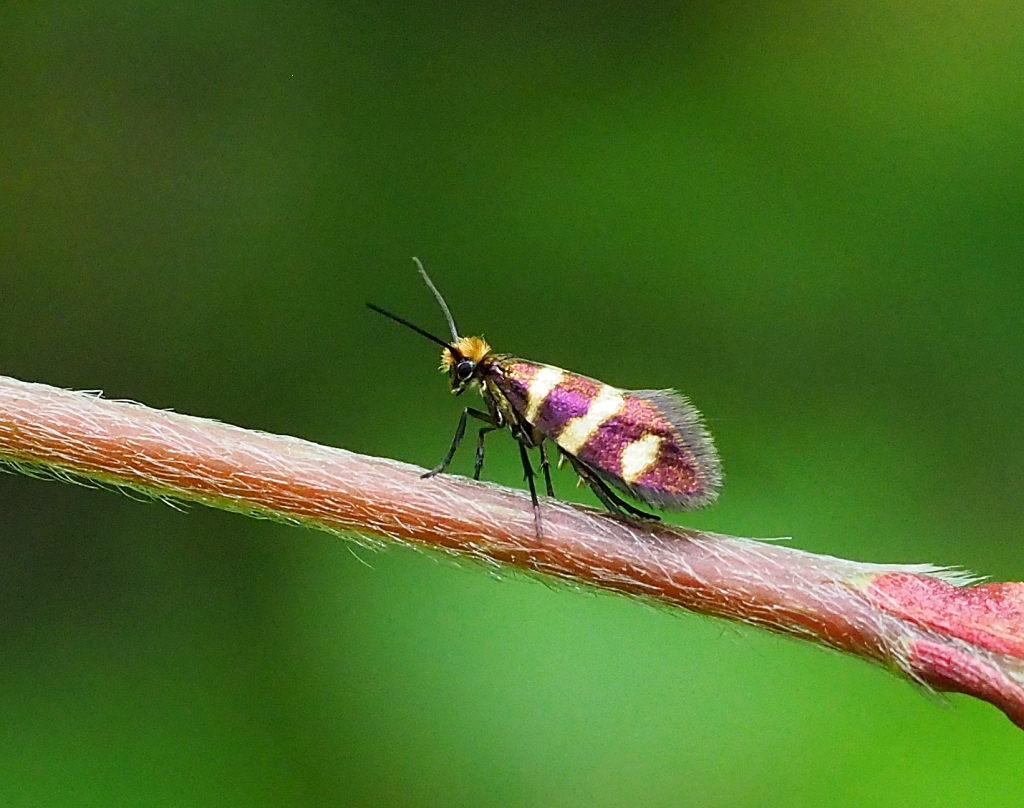
A wander around The Ross this afternoon, during a brief respite from the rain and the boxes, found Micropterix aureatella, a moth I think I've only seen once before. Small (5mm), but stunning.

Micropterix aureatella

I found the moth because I was looking at some leaf mines on the young Beech leaves. All along the roadside the Beech was getting seriously hammered.

Beech Fagus sylvatica, upper leaf surface.

Leaf underside.

My expectation was that this was moth larvae doing this but I was wrong. And I thought I found an adult culprit, but knocked it off the leaf whilst trying to get some photos. Orchestes fagi is the culprit, a weevil. However, the weevil I dislodged was too large, and looked more like a "blunt nose". I'll need to go back and try to find adults of O. fagi and of the other species. However, larvae were visible in the leaf mines. There's also some Ransoms Allium ursinum along the same lane, I have a feeling that can host some interesting beasts at this time of year.

Monday, 29 April 2024

Final laps, maybe

This could be the penultimate post, not of the blog, I hasten to add, but of Literate Herring This Way being based in Orkney. Hopefully, we're twelve days from sailing south, permanently. The house is littered with packed and semi-packed boxes and things. Large and important things, like the piano, have been sold. Many trips to charity shops and the tip have been taken. My trailer will be the next to go.

Make me an offer.... Gone..... I'm sad to see it go.

Quite sad to let it go but I won't need it and it will take up parking space unnecessarily. It's a bit knackered, with a bit of the floor broken, but it's not let me down, only jumping off the hitch once, which was a tad scary.

The other week BH and I had another roam around his garden on Burray during which we found two or three species of beetle that were second records for the county, I got at least three lifers, two beetles and a bug. It took a while to sort everything out of course, the usual two hours in the field = ten hours in the "lab" (otherwise known as a kitchen). Many things were photographed so that the records could be proven. My personal highlights were Philonthus decorus, many thanks to AKH for his help with the identification, and Phaedon tumidulus, which BH had previously found just a few weeks earlier. Otiorhynchus porcatus, Cercyon littoralis, Atomaria nitidulus and Leiosoma deflexum were the other beetle species we found that are not ones I see too frequently.


Philonthus decorus, a female, so no genitalia images but a definite ID thanks to AKH.


Phaedon tumidulis

The rough grassland and inter-tidal zone at Westshore seems to be a particularly good place for beetles in Orkney. Quite a few local "rarities" have been found there.

We found quite a few more common things as well, a nice Phosphuga atrata, always welcome; Small Tortoiseshell and there were some slugs photographed which I haven't got around to yet.

Phosphuga atrata, a predator of snails.

Small Tortoiseshell, my first free-flying one of the year; there had been one we found in the garage previously.

We'd wandered around with the EMP lure all morning, but no takers there. I got home, leaving the bag the lure had been in the garage and an Emperor Moth appeared quite promptly. And then another Small Tortoiseshell as well, it was a fine day.

It's been a good time for beetles with a trip to a certain location producing unexpected, due to the early date, plenty, in the form of seven Prasocuris hannoveriana on one plant, six of these were pairs in cop. UK wide this is a very uncommon beetle with a weird distribution. There are possibly three sites in Orkney. I've searched many other places and failed, the food plant is Marsh Marigold.

Prasocuris hannoveriana

Another fine day and Louise and I walked out on to The Brough of Birsay. There were Wheatears and there were Fulmars.

Wheatear, female.


Fulmars.

Around The Shunan there have been Swallows a couple of times, and most extraordinarily a White-tailed Eagle, on the deck, which went paddling. The photos are rubbish as it flew and mostly kept it's back to me but an extraordinary record.


White-tailed Eagle, sub-adult.

In the last week there have been Brambling, 3+; Siskin, 3+, Chaffinch, 2+, Chiffchaff, one singing, Swallow, a couple today around the house and garden. Hard to match the excitement of the Great Tit! 

Brambling, male.

Most exciting have been the sawflies I've been finding. So far I've (with considerable help, thanks JS, AG, IA and AM) only identified two of these, and one of these two is somewhat pending, as it has not been confirmed. The specimens will be handed to JS shortly. There are very few records of Dolerus coracinus in the UK (I've previously posted about this one). But then I found two others, one looks to be coming out as Euura clitellatus. Having just found images of this species on the Sawflies UK website, of a male, I'd thought there were only images of the female, I'm considerably more confident about the ID.

8th tergite, post dissection.


8th tergite before dissection.

Penis valve.

Euura clitellatus, a male.

In the garden yesterday I did find Syrphus torvus whilst mowing the grass, it settled on the fuel can.

 
Although it's a female you can see the eye hairs quite clearly, Syrphus torvus.

Today a stroll around Birsay Links and the cliffs towards Marwick. Disappointingly the cliffs where I sometimes photograph auks were bare. However, the Links beach was a tad more rewarding with four monstrous Broscus cephalotes (and another carabid I need to ID).


Broscus cephalotes.

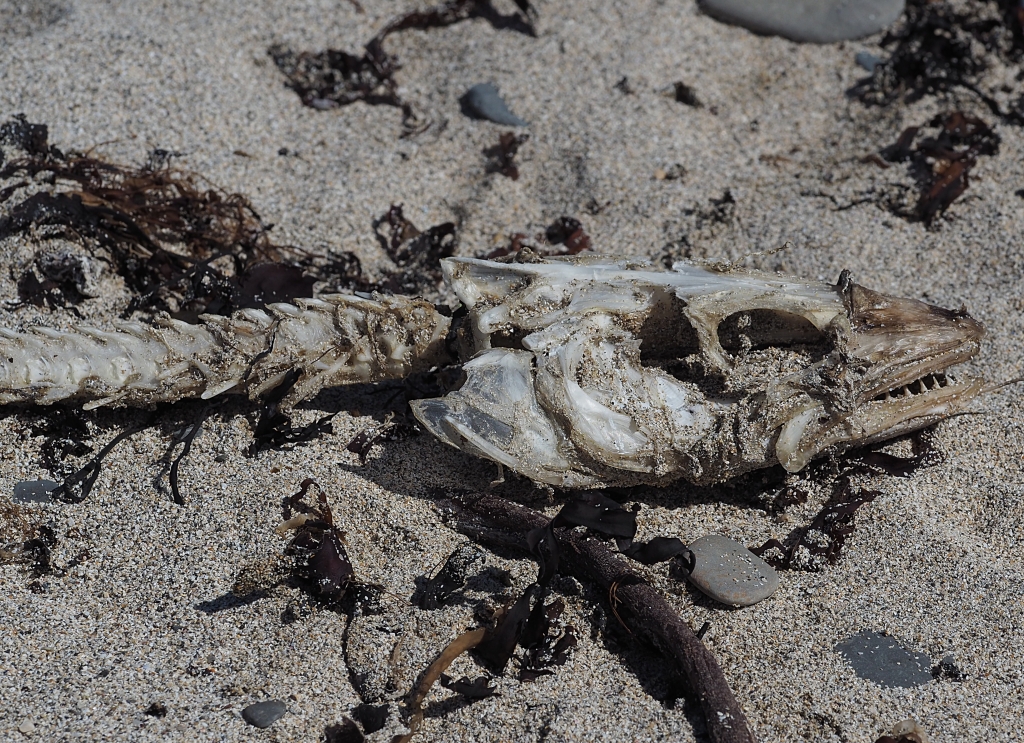
Also on the beach this head and neck which are I think of Conger Eel. Re-identified, after a bit of research this is a Ling, Molva molva. The head was about 150mm long.


Conger I think. A check and it is Ling Molva molva.

The Brough of Birsay.