Friday, 13 October 2023

Twitchy.

If on the day of the EbT I'd have dropped in at The Loons I would have found a Ring-necked Duck. As we went past on our return from the coast I had thought about it, nearly stopped, but didn't. That, of course, would have thrown the timings out for the afternoon, and then perhaps the Eyebrowed Thrush would have been in our garden undetected. Been and gone, unseen.

Anyway, I did subsequently go and see said duck, twice. It's a confiding beast, generally hanging about and feeding right by the hide.


Ring-necked Duck.

There have been a couple of other interesting birds within 15 minutes of home (by car). We dipped the Cattle Egret on Monday by about five minutes as the cattle were moved and it relocated. That was en route home as we were coming back from South Ronaldsay (more of that later). But in the rain, rain and more rain yesterday we went for another look... and failed again. To rub in some salt we also dipped the Glossy Ibis on the same wee tour around.

On Sunday we had early visitors, locals hoping to see the EbT. It had gone but we all enjoyed a bit of a gab, emptied my moth traps, for the total of two Angle Shades and a Silver Y hiding in the conservatory, they keep coming in for the Honeysuckle, finding their way in by the windows that are open a crack.

It is an Angle Shades.

Monday was as fine as the Met office promised, although the thick, drizzly mist was initially disconcerting. Despite it we headed for South Ron. Louise fancied a walk and I had a couple of lifers lined up, a cunning plan as Baldrick would have it.

We walked from Windwick north. It's a spectacular bit of coast. Goldcrests came in/off the sea and landed feet from us, I chose to look rather than photograph. 20 or so Whoopers went north, 80 or so Pink-feet whirled around. There were a few Silver Ys and I was hopeful that the cases I found on smaller rush might be Coleophora glaucicolella, but they turned out to be C. alticolella after all.

Case bearer, Coleophora alticolella.

Near Windwick, looking south.

Before heading to the very good cafe for a late lunch, the planned twitching excursion was actioned and we headed a mile or so off down small byways to South Flaws cemetery.

Things were not promising when we arrived. Signs of recent grass mowing... However, we were seeking small things and began to scour the close mown grass. Louise came up with the first of the sought. 


Cordyceps militaris.

The colloquial name is Red Caterpillar Club which sounds as if there should be a mighty garish rave involving vivid Lepidopteran larvae somewhere out in the wilds. But the club refers to the shape of the growth, not a gathering of like-minded moths, garbed similarly. The biology is interesting though, as this fungi is a parasite of moth pupae and grows up through the soil where they have buried themselves to spend the winter. No, the moths will not emerge.

One more thing to find. We'd just about given up when some bright yellow caught my eye, and there was the tiny Meadow Coral.

Clavulinopsis corniculata.

Mission accomplished, off to the cafe, which specialises in some very tasty Middle-Eastern food, perhaps surprisingly, sited on Burray (the next island north).

As we were leaving the cafe, a phone call (thanks AL) alerted us to Orkney's 2nd ever Cattle Egret. We shouldn't have stopped for a quick Tesco shop. We arrived as the kye were being moved, no egret to be seen. 

I've seen plenty of Cattle Egrets though, although but one in the UK. I'd not previously seen Calliphora loewi which I caught in our kitchen on our return home. A window had fortuitously been left open. It took me pretty much all the next day to identify and photograph but I got there in the end. A real northern specialty, but not previously recorded with certainty from Orkney. Armed with my new key it wasn't exactly a piece of cake to ID but it was possible.


Male genitalia, diagnostic.

Calliphora loewi, just 150 or so records on the NBN.

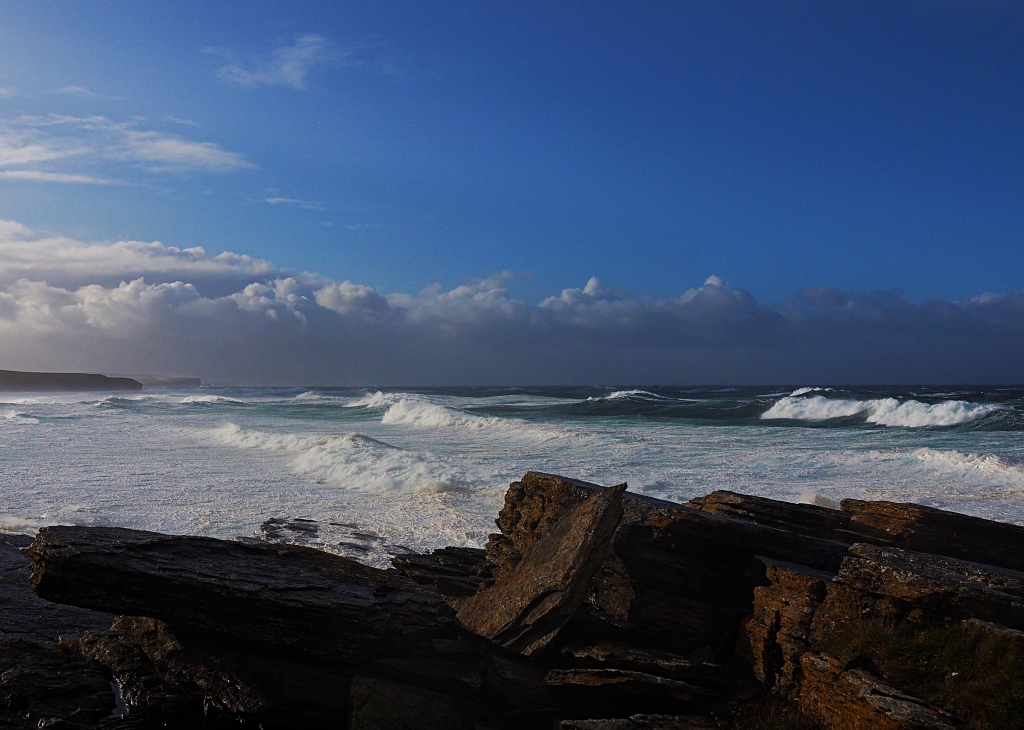
It's been a stormy week and it looks like continuing. A half-hearted seawatching expedition ended up being more of a photographic outing. More hooley to come, 60 - 70mph gusts forecast for the weekend.


EbT post-script:

The twitch.


Saturday, 7 October 2023

Eye-browed Thrush in the garden.

I've found a few rare birds, should have, I've been at it for 62 years (I reckon to have started birding when I was six years old). I think this is the only mega though, a few BBs along the way, plenty of county level stuff. Of late, although I still go birding pretty much every day, invertebrates have been my main interest. 

Today started with moth traps, three traps two moths, somewhat disappointing, just Angle Shades and Small Wainscot. It was after breakfast, late morning that I noticed the Redwings dropping in. A few at first but then a flock dropped out of the sky, as they do. I had a couple of quick searches around the garden to no avail and then headed for the coast where there was no obvious incoming of migrants.

At home again lunchtime and more Redwing activity with further flocks doing the dropping out of nowhere. We have Swedish Whitebeam in the garden and they were an obvious target, berries were disappearing at a rate. But, each time I went round the trees the flocks headed off.


Redwings scoffing Swedish Whitebeam berries.

There was also a bit of Swallow movement, a House Martin, Pied Wag and a few other bits and bats. However, I've been looking for moth larvae recently so elected to head off down the hill, check The Shunan and wander across the fields. Target species Chlorophora glaucicolella.

Dipped on the moth, couldn't find appropriate food plants. And eventually headed back up the hill to the house via a few diversions.

Redwings were very evident in the back garden and in between tea and cake and more tea I kept checking them. Hummed and hawed about going out on the bike. Had another look at the trees. That's odd, that Redwing has no breast streaks, and it's all red-brown down the breast (it was face on). It went down on the ground in the vegetation, definitely no breast streaks, neat little wing bar, rather different face markings, more restricted, less clear. Grabbed the camera which was handy and managed to fire off a few shots. Look at the camera back, no I wasn't imagining anything. Now wracking memory... too small and not right for Red-throated Thrush. Grab the book (Wildguides is always on the kitchen window ledge) .... various expletives. Fumbled the phone. AL lives just 10 mins away, gave him a ring.


Eye-browed Thrush first images.

When AL arrived he confirmed that I wasn't mad. And it was general relief when both AL and Louise had confirmatory views and we got some better images.  At this point I put the news out on What's App.


Eye-browed Thrush

A couple of folk quickly arrived for the twitch but all the time the light was failing and the bird, having presumably stuffed its wee belly with berries was showing more intermittently and briefly. Last seen a bit before 5ish.

Well that was a bit of a do. And I didn't see a Greenfinch all day (again).

Friday, 6 October 2023

Seek and you may find...

And if you don't look you won't find anything!

Despite dissecting a good few berries I couldn't find the culprit that appears to be burrowing into them.
 
The Hawthorn hedge, where there are a few berries to check.
 
The damp fields below the house are full of Juncus effusus, Soft Rush. Last year I found the case bearer Coleophora alticolella for the first time, after I'd been given the heads up to look. Just examine the seed heads and you should see little "rice grains". I've looked for this year in the last few days and found them again, in their hundreds. Examination has again, so far, just found the one species of moth C. alticolella, there is a congener that behaves in a similar manner, the caterpillars are separable with careful examination.
 

That may be a Hymenopteran egg on the case. A number of species parasitise these caterpillars. I was led to a Durham University PhD paper about the development and parasitisation of C. alticolella which was an interesting read.

Coleophora alticolella, lateral scleretised spots reduce in size S1 to S3, oddly this one did not have a sceleretised spot on abdominal S9.

These flies, big and buzzy, have been around the entrance to the moth trap at night. Eventually, I managed to catch some and with help, thanks SW, got to the identification of Polietes meridionalis, a species only identified in the UK in 2015. There is a congener, P. lardarius, but I haven't found that yet. To be honest they're a bit of a pain, buzzing around the entrance to the trap, and they are large. Identified by the yellow face and yellow front thoracic spiracle, those bits are grey on P. lardarius.


Polietes meridionalis.

Another light trap intruder, found when I was cleaning it up later on was this Psocoptera (barkfly).


Graphopsocus cruciatus,

The last new insect of the week, well there will be more once I get around to all the Hymenoptera, and there was a beetle in these Gorse pods as well as this caterpillar of Cydia ulicetana.


Cydia ulicetana in Gorse seed pod.

On the bird front the Pink-feet are arriving, flocks on three days in a row.


Pink-feet arriving.


Reed Bunting, numbers increase in October with some migrants arriving.


Pied Wagtail, birds moving through and numbers decreasing through the month.

The moth traps have been having some long overdue maintenance. Checking wiring, replacing connections etc. I temporarily swapped the 20W Wemlite, which I've used for a long time and is rather wobbly for a newer model. It didn't last long.


Water most likely the cause.

So I ordered some new bulbs from Paul Batty - http://www.pwbelg.clara.net/mercury/ and a new bulb holder, a ceramic one just in case I do want to run an MV. I managed to get the last 20W Wemlite in stock and a 13W version to test. But I also thought I'd have another go with an LED, my previous one I used years back was not a great success but these 9W ones look as if they may be the business. The plan is to have a bulb holder by the back wall that I can keep an eye on, as well as the usual traps. A 9W LED will go in combo with a synergetic in my Robinson.

9W LED, 20W Wemlight, bulb holder and 13W Wemlight.

And here's the Sun partially obscure (not by clouds!) but by North American smoke.

The Sun

Tuesday, 3 October 2023

Autumnal(ish)

Warm yesterday, sitting outside with tea and home made scones in the late afternoon, without a coat.

It is autumn though, there was a Yellow-browed Warbler in the garden the morning the day before. It happened to have a burst of calling from the clump of trees where I see most warblers in the garden, and I managed to glimpse it. Not much else of note though, there are ducks on The Shunan, a tagged Buzzard hanging about, a Shortie the far side of Bosquoy from my bike ride and a flock of 52 Linnets.

Moths have been few and far between, but in perfect conditions last night, other than rather a lot of rain at some point, I got something interesting. At first glimpse in the trap I thought it was a 2nd gen Common Marbled Carpet, but more careful examination of the images later proved otherwise. NFM and this for the site Grey Pine Carpet.


Grey Pine Carpet, Thera obeliscata.

This species can be a bit of a tricky ID, I think mostly in it's grey form, it can be almost indistinguishable from Spruce Carpet, and dissection of the genitalia apparently doesn't help. However, T. obeliscata males,have plain antennae with symmetrical segments whilst T. britannica males have asymetric antennal segments. Unfortunately this was a female when I checked, I had initially thought it to be a male. 

Fortunately a number of folk came to the rescue and especially SS who very kindly annotated a number of his photographs of both T. britannica and T. obeliscata and confirmed the above as Thera obeliscata. Excellent!