Sunday, 19 July 2020

A small death

The title of Samantha Crain's album which I'm listening to as I type but also the sad end of a potentially beautiful animal, killed before its first flight.

Curlew 1cy.

There have been a good number of Curlew pairs with chicks around us this year, they will nest in hay and silage fields though. The field was cut yesterday. Our attention was brought to the small tragedy by the Bonxies and Hoodies in the field, arguing over the corpse. By the time I got to take the photo there was little left. They don't stand much chance with modern farm machinery, it's big and fast.

On the positive side one of the Bonxies certainly looked like a 1cy (this year's bird), which is encouraging as skuas are having a pretty grim time.

Sowing Yellow Rattle seeds.

Collect Yellow Rattle seeds now. Rip up a bit of turf and scatter some seeds within. It worked last year and we're starting to get it established. As well as the large area of uncut meadow, full of Orkney Voles but also great for all sorts of insects we're not cutting some fairly large patches of the "lawn", or at least cutting higher and a lot less. I'm trying to improve the plant diversity of the meadow as well, Yellow Rattle helps with that as it parasitises the grasses weakening them and creating gaps. Encouraged by the Adam Frost led episode of Gardeners' World last night, gardens could provide so much more wildlife habitat, there was some good guidance on the programme.

A good patch of Cat's Ear in the "lawn".

Some good news, surprisingly the Arctic Terns are breeding at Skiba Geo, despite apparently deserting the site they returned late and perhaps ten pairs are now breeding with chicks seen today. There appears to be plenty of food, it will depend on the small numbers holding off the skuas and gulls. We saw fledged young from the Skaill colony during the week.

The sky was extraordinary earlier in the week and I had an attempt to see the comet, Neowise. Failed in that but watching the moon rise was, er, cosmic. The cloud was just blobbed on top of the comet I think, this Tuesday is looking possible, no cloud hopefully.

2 a.m. looking NE, noctilucent clouds in the background.


I stayed up through and closed the light traps at about 03:30. 240 moths of 39 species and a fair variety of other things. I'm building up a bit of a backlog of Caddis to ID.

I'd swapped the traps around as I wanted to see what was most effective. The wee Heath trap with the synergetic is probably my most effective trap. The Robinson running a less bright round synergetic with a black light is ok though, I ran that off a battery at the Wee Wood. Earlier in the season when I have run the Robinson with an MV it hasn't done that much better. I'd like to put vanes on the Robinson, I think that might improve it considerably.

Nothing spectacular, a few new for the year, last night's Pinion-streaked Snout is probably the best moth of recent days.

Pinion-streaked Snout.

I've discovered that dissection and fancy solutions are not necessarily essential for gen det on caddis, this helps a lot. I've managed to get a few things to species with more certainty. Here's a new one for me.


A male Limnephilus rhombicus showing the diagnostic genetalia.

Had a bit of an attempt at some sawflies as well. These are not quite as impossible as I thought but there seems to be quite a lot of conflicting information. With some genera it is difficult to be confident about identifications, especially when sites such as Nature Spot and Steven Falk's Flickr appear to conflict (I'm inclined to go along with SF). 

Anyway this one is good, found dead in our pony's water a couple of times.


Pachyprotasis rapae, a fairly straightforward one.

They are certainly attractive insects.


Monday, 13 July 2020

Cycle

It was sunny and still on Thursday so I cycled down to the Large Heath site to get my annual fix. I had twelve or so sightings in an hour, one or two quite close but nothing photographable. I need to have a look around some of the other likely sites that are closer to home, need a sunny, still day though.

Large Red Damselfly.

I'd not seen damselflies at the site before so was pleased to see four or five of these.

Also some nice plants which I haven't got around to looking up.

I'm being lazy, I need to look this up.

Platycheirus manicatus on Marsh Cinquefoil (Potentilla palustris).

Hare's Tail Cotton Grass.

Hare's Tail Cotton Grass.

I checked a couple of sites for damselflies on the way back, Large Reds at one, Blue-tails at another but small numbers.

Curlew.

Curlews by The Shunan have chicks, despite the Stoat family living nearby. Tufted on The Shunan with eight chicks, the Shoveler still has one, and there's a new brood of  six Mallard. On Bosquoy one of the pairs of Mutes has a large chick, a few Tufted broods in evidence too,

Wednesday, 8 July 2020

A good day

Yesterday evening Louise called me outside to look at a "small yellow moth", expecting a Brimstone I was a bit unwilling but stirred and was pleased to be surprised by a much smaller moth indeed, one of my favourites, Acleris bergmanniana. The weather being grim and the light being poor I potted it to photograph this morning.

This morning photography completed I took the moth to the small walled garden to release it.

Acleris bergmanniana.

I was half hoping I might get some photos of the moth on plants and it duly obliged landing on some nearby vegetation as I released it. However, as I was getting the camera ready something caught my eye. I'm quite interested in the "picture-winged" flies and have added Palloptera satuum to the county list from the garden. However, this was something a little larger and a lot more striking, certainly a species I'd not seen before.

I managed to get a shot or two taken before chickening out and potting the fly, just in case.


Fortunately I had a decent image. The problem then was to identify the beast. Initial investigations led me first to Herina frondescentiae, but looking more closely I decided that wasn't right. The next thought was Euleia heraclei, the celery fly, but I wasn't sure. I'd already tweeted the image and brought it to the attention of the county recorder. I had stuff to do so went and did stuff. 

A while later I had a Twitter message that the CR thought the fly was Philophylla caesio and had made that suggestion to Ian Andrews. By some weird coincidence Ian had a specimen of that very species right in front of him and replied to confirm. This is perhaps not the most likely beast to turn up in my Orkney garden, there are just three Scottish records in NBN and the closest is a little south and east of Inverness. NBN says - "Philophylla caesio is a species of fly in the family Tephritidae, the gall flies. It is found in the Palearctic. The larvae mine the leaves of Urtica". So a new species for the county, and although I didn't identify it myself I'm still pretty pleased.


Philophylla caesio, release picture,

I should have kept the specimen really but I try to avoid killings things if I don't need to.

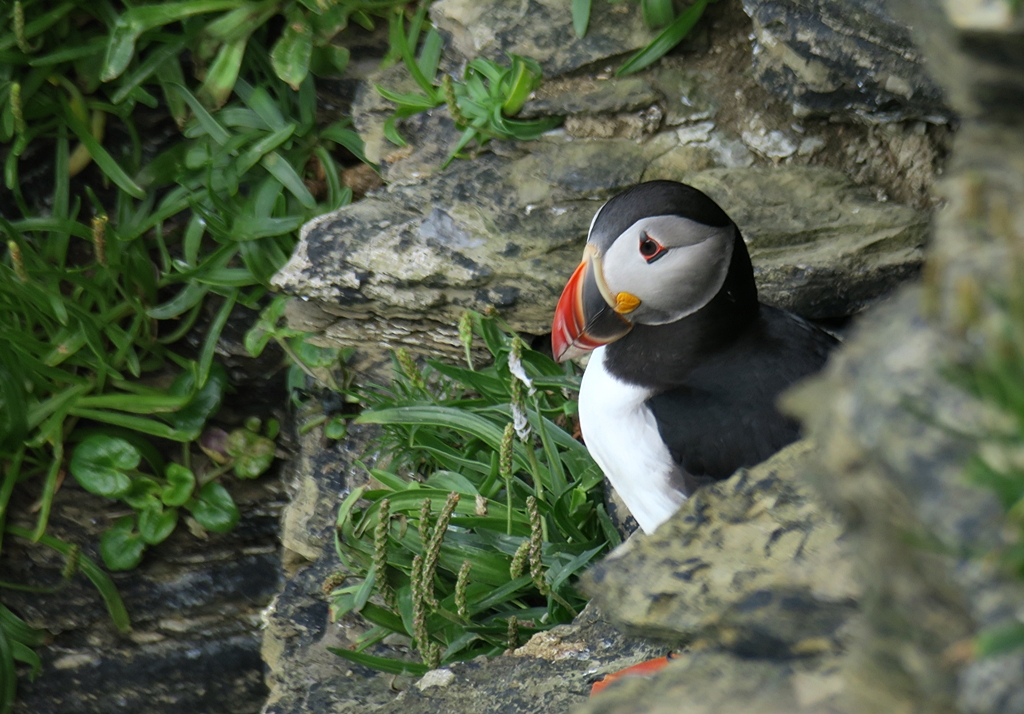
Apparently today was international seabird day. So, here are some gratuitous Puffin pix.


Atlantic Puffin.

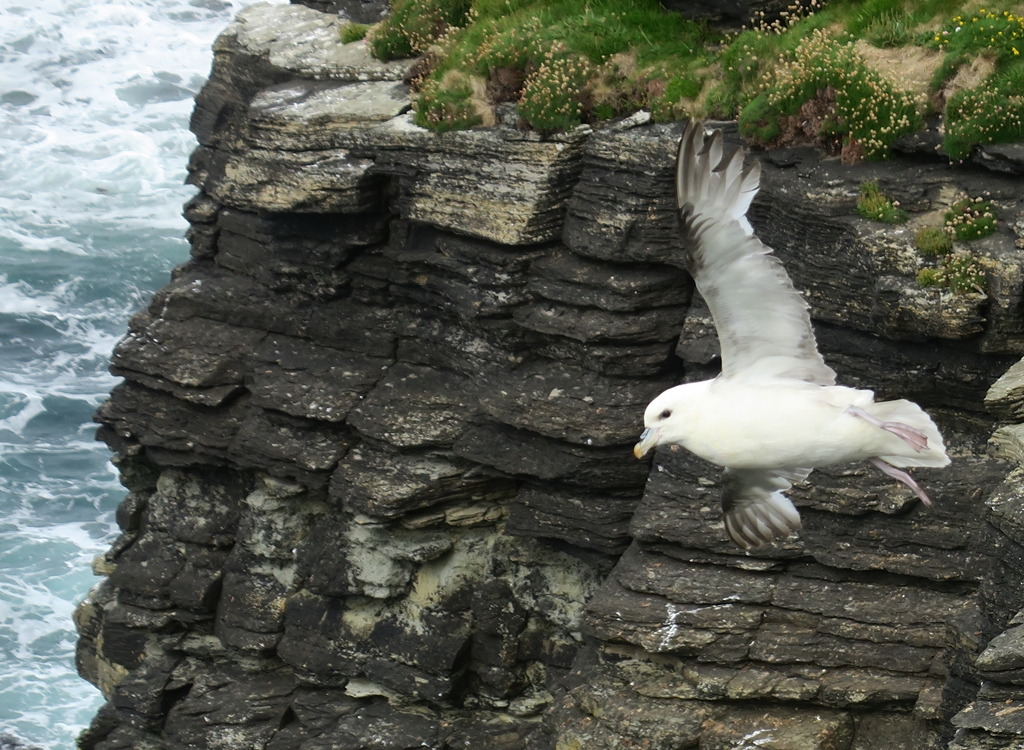
And a Razorbill and a Fulmar or two.

 Razorbill.


Fulmar.

The stuff to do - go for a walk. Also picked up a click beetle which I haven't got around to yet.

Moth traps are out, including at Wee Wood and a wander around an hour or so ago found a record 19 Ghost Moths lekking and mating, 50 - 100 Silver-ground Carpet and plenty of Noctuids bombing about. A good day indeed.

Sunday, 5 July 2020

Those of a delicate persuasion should look away now - this is brutal.

The Woodpigeons have taken to messing about in a corner of our little walled garden. We're not sure what they are up to but it has been since we cleared the corner out a bit and put in some new plants. A Hooded Crow pair have nested in the back garden, in a conifer right by the house, yet again they have failed, but they are still holding territory. Last night it rained and it was still raining this morning.

Mid-morning Louise called me over to the bedroom window as a Hoodie was down in that corner of the garden and had a Woodpigeon cornered. The Hoodie was going in like an expert boxer, picking her shots (pretty sure it was the female of the pair responsible for this as she is a lot smaller than her mate). She was having a serious go at the Woodpigeon, feathers were flying.

Now a Woodpigeon is a mighty strong bird, try ringing one. They are very strong and very hard to hold. The Hoodie was being cautious, she was not prepared to attack face on but kept manouvering to attack from behind. The battle spilled out of cover and into the open. Slowly but surely the crow was wearing the pigeon down, going for the head and neck and causing some serious damage.


At this point both birds look bedraggled but the Woodpigeon is in a bad way. However, the battle is not over. The Hoodie was still unwilling to take a direct approach and was getting behind, pulling wings and tail and then attacking the back of the head. The Hoodie started to eat the still alive pigeon, every now and then it made another effort to resist, but eventually the crow killed it.


 The male of the pair then arrived for his breakfast.

An hour or so later this is all that was left.

The crow must have observed the Woodpigeon behaviour and taken advantage of an opportunity. Then strength and determination resulted in a meal.

I'm just surprised that the Hoodie was prepared to tackle such a powerful adversary.

On holiday

Phew, got there. A week shorter than it should be but better than nought.

Moth traps have been out. No big effort as the weather has not been quite right but I've run the Heath traps for a few nights. Nothing spectacular but a few nice things.

These two characters might be Eudonia alpina, equally, however, they might just be angustea. I can't see the white lines on the forewings well which are diagnostic apparently. There are some features which make me think they could be and they are big, 11mm, and it's the flight time, apparently. I'd like to nail alpina, it should be possible here. I've had possibles before but I don't think I've ever had one confirmed, certainly not in recent years.


Opinions welcome - Eudonia angustea or maybe alpina.

I've spent a lot of time messing about with these beetles found in the Rook pitfall traps. MT helped me and got me to Catops, I had managed to get as far as Leiodidae under my own steam.

I found a Catops key but then it has been suggested that probably only dissection of male genitalia is reliable, these things are quite small, my microscope needs replacing and I'm not too good at that kind of delicate stuff these days. Probably best to give the specimens to someone else.


Expanded front tarsi = male. Antennal segements 8 and 6 are shorter than long and the elytra look a bit shiny (other pic) so maybe it is grandicollis. Equally, it might not be. Probably the point at which to surrender.

Various other things to identify, a caterpillar, a sawfly larva, a couple of craneflies and Aphodius beetle. They have messed with all the names of the Aphodidae, this is now

Bodilopsis rufa (was Aphodius rufus), confirmed, thanks DM.

Here's a selection of stuff I've either not really had a go at or are out for consultation:

 Somewhat mangled Green Gem, Black Gem, Microrhysa flavicornis cyaneiventris, (thanks LJ) getting loads of these everywhere at the moment. Resources for soldier fly identification now placed in the side panel under Diptera.

Cranefly to be sorted. Dicranomyia sp.

Micro cat I think.

Another of these dark Endothenia quadrimaculana (I think).


Sawfly larva.

Philaenus spumarius.

A good few caddis to work on but Limnephilus marmoratus, and (likely affinis) plus another huge Phryganea grandis/bipunctata.

I walked along the cliff east of Northside, it is one of the places where there is little dumping of rubbish (just one small area) and it is very quiet. Scattered auks, Shag breeding and when you get to the top of the hill a great view of The Brough of Birsay. Rubbish photos of Puffin so I deleted.

Brough of Birsay.

Yesterday we went to Brodgar. Normally in the summer there would be coaches in the car park and the place would be full of people until you walk past the monument. There were very few folk there.


Ok for us, not so good for many Orkney businesses, there are real problems for lots of the hospitality and tourist businesses. I think there will be a few gaps in the high street when this situation is past. Our favourite pub in Kirkwall has gone apparently.

Skylark with food.

A few birding things today: the Shoveler on The Shunan still has her one chick, Tufted with six chicks on Loch of Bosquoy and Teal, late, with two small ones as well. A pair of Siskin have been hanging around, the Goldfinches have raised at least one chick and a Grey Heron has taken to sitting in the Wee Wood.