Sunday, 8 August 2021

Three wasps and an aphid (or two).

I was chatting to my neighbour when he mentioned wasps on his Scot's Pine, and a Wooly Aphid. My interest aroused I asked if I could take some photos. I expected the wasps to be Dolichovespula sylvestris, the Tree Wasp, as that's the one we see in our garden. On approaching the pine I quickly realised these were something else as they had orange blobs at the top of the abdomen. It took me a lot of photographs, on this windy day, and a fair bit of research to manage to identify the wasps as Vespula rufa, and not Dolichovespula norwegicus, the other one with orange/brown abdominal markings. 

Vespula rufa.

My neighbour had thought the wasps might be predating the Pine Wooly Aphid which he had found in the tree, Pineus pini. The wasps were certainly searching through the foliage.

Pineus pini "wool" in the Scot's Pine, this aphid would be new for Orkney I think.

Going through the photos I was especially pleased with this one and then delighted when I realised that the wasp was in the process of eating the aphid, well that's what it looks like to my eye.

Vespula rufa with Pineus pini a nymph of Cinara pinea (Large Pine Aphid), also found in the tree.

A bit more investigation and I found a likely candidate for Vespula vulgaris as well, bit of a tricky ID.


Vespula vulgaris, very likely, awkward to ID with certainty, they are very variable.

Interestingly, despite them being fairly frequent a few yards away in our garden there were no Tree Wasps, Dolichovespula sylvestris in the pine.

However, when I got home, Louise who had been having a bit of a clean had caught one in the house.


Dolichovespula sylvestris.

Social wasps were first recorded in Orkney in the early 1980s I believe. In the last few years I have seen only Tree Wasp in the garden, this was a wasp fiesta. I'll need to go back and see if I can find the aphid not within a wasps jaws.

I did go back and found there were other aphids present. Pineus pini should only be about 1 - 2mm long and they don't run about in the foliage. The aphids I found were larger and through the excellent photos at Influential Points I reckon they are the Large Pine Aphid Cinara pinea.


Cinara pinea, a slightly damaged one and an earlier instar in the tree.

Aphid identifications now confirmed, thanks to Dr RD.


Friday, 6 August 2021

Snorkeling.

 The snorkel mask and fins arrived yesterday so it was down to the sea. The water was uncomfortably colder than Arran for the first five minutes, but then that was forgotten with looking at everything and taking pix. I'm not the strongest swimmer or the most confident so the new fins were a bit of a boost on the falling tide. With -2 corrective lenses in the mask I could see far enough in front, and see the camera as well, handy. This was all a bit more necky than where we swam in Arran so care was required. Louise being a confident swimmer was quickly off into the distance but I stayed in the proximity of the beach. Once I got used to quickly being out of my depth and gained a bit of confidence with the new snorkel I began to concentrate on the underwater world. Nothing spectacular but these wee purple jellyfish-like creatures were all around me.

Medusa of a hydroid, not a jellyfish as such.

Identifying these doesn't really matter, I've not had a suggestion yet that such things are identifiable. Beautiful creatures. From 60mm diameter down to 20mm.

Medusa again.

Plenty of plants down there as well, my terrestrial botanical skills are flaky enough so I stuck to the basics.


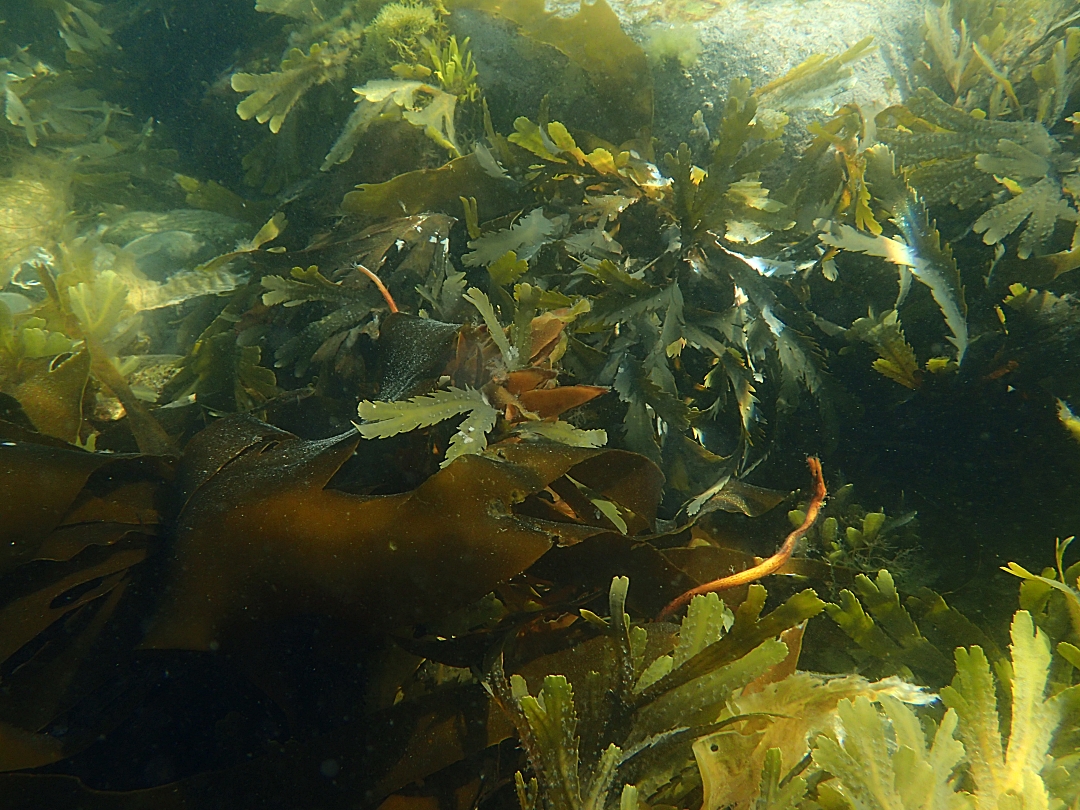
Fucus serratus and a kelp which I think is Laminaria hyperborea (Cuvie) but I'm not 100% on that.

Sugar Kelp, Saccharina latissima.

Sea Lettuce (the bright green stuff, Ulva lactuca).

Pictures taken with the trusty Olympus Tough TG-4. I foolishly missed an underwater case for my PEN on ebay, but on reflection I'd have needed lights and a load of stuff, the TG-4 is easy to swim with as well.

Looking forward to the next time.

Monday, 2 August 2021

Back from hols two.

 The mystery moth from yesterday has turned out just to be an odd Dusky Brocade, unless anyone has any better ideas. SS had, it's a Nutmeg and I'm dead chuffed! Thank you.

Dusky Brocade I think. Nutmeg!

I had some hopes of this being Confused but the stigma are large and the subterminal line is not right, despite the leading edge of the forewing appearing to be pretty straight. Just a weird, worn and pale Dusky Brocade, but very happy to be corrected. And corrected I was, very grateful as Nutmeg is uncommon here and NFM. Always very happy to be put right with my IDs.

A wander at Northside this afternoon in perfect cetacean spotting conditions (flat sea, grey sky) eventually produced four or five distant Risso's Dolphins, one of which did a nose flip and came pretty much right out of the water. More unusual was the potter wasp Ancistrocerus scoticus which I've never previously found at this site, it was feeding on Wild Angelica.


Ancistrocerus scoticus.

I was again checking all the Ragwort for the hoverfly Cheilosia bergenstammi, no bananas. However, a nice Middle-barred Minor.

Middle-barred Minor.

There were lots of Swallows but not many other birds of note, a couple of dark phase Arctic Skuas chasing Kittiwakes being the best. This Meadow Pipit posed nicely though.

Meadow Pipit.

The main purpose of the outing was to suss out some safe snorkling spots, and I think we found some spots where we would feel safe and find some interesting things.

Saturday, 31 July 2021

Back from hols.

We went to Arran, as we have a few times before, and again stayed in our friends' house whilst they were away elsewhere.  I took the Heath trap with synergetic light and had a very busy time with moths, so many species that I am unfamiliar with, despite trapping at this site a few times in the past. I'll post the moths shortly(ish) and hopefully some kind readers will correct my identifications, some of which (at least) are likely to be somewhat wonky.

Going so far south there are many species that I just never see here, and of course more mammals. Badgers (almost nibbling our toes), Red Squirrels, bats (I forgot to take the bat detector) and Bottle-nosed Dolphins were stand out. I failed to identify a vole glimpsed a couple of times.

Red Squirrel through the kitchen window.

Not much on the bird front except excellent views of Golden Eagles on a number of occasions and Hen Harrier twice, not a species I've seen very often on Arran in the past. The Bottle-nosed Dolphins performed very nicely alongside the road as we drove for the ferry.

Common Sandpiper.

Being on holiday I took my wetsuit and there being a lack of boats, as our friends had taken their kayaks with them, I went in the water a bit, armed with a 20 quid Lidl snorkel and the TG-4.

Twin-spotted Goby, Gobiusculus flavescens.

Pollock fry, Pollachius pollachius.

Serrated Wrack and kelp.

Shore Crab.

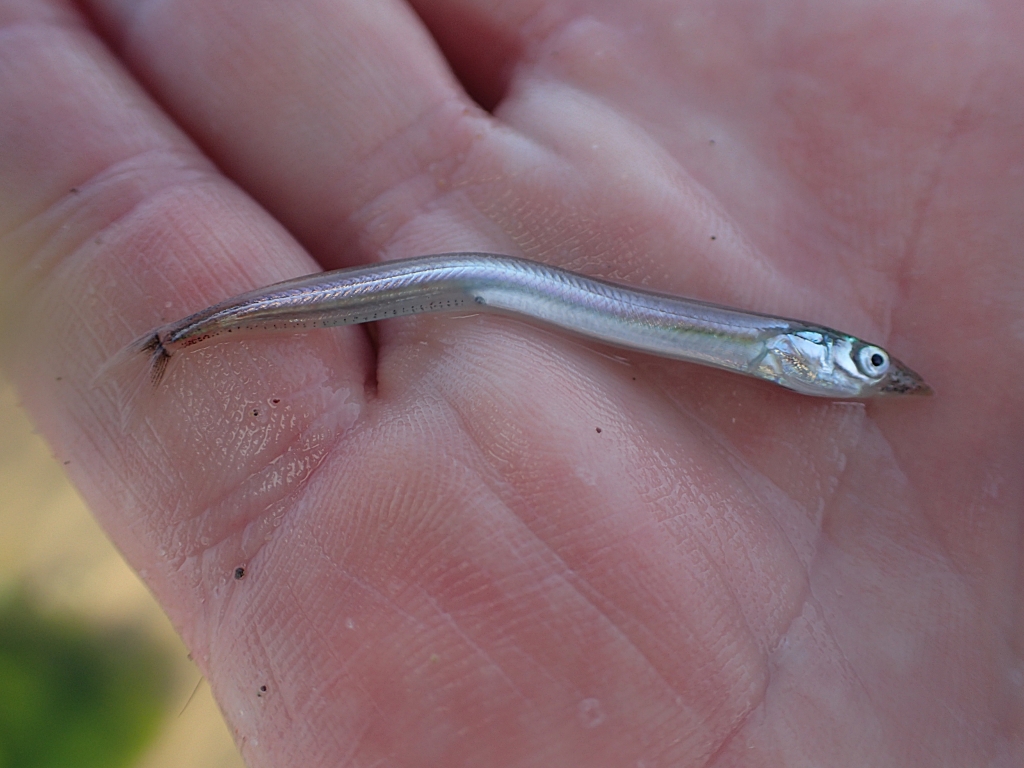
Also got some images of Lesser Sandeel by wading around in the shallows. I found one injured one and had several goes at photographing the small shoals. I watched two bury themselves in the sand so quickly when they detected a threat; me.


Lesser Sandeel, Ammodytes tobianus. This would seem to be a safe ID although splitting the five UK species is a bit tricky.

So many other things to look at, photograph and identify, I was a bit overwhelmed. Fortunately perhaps, I wasn't distracted too much by hoverflies as they weren't much in evidence, probably due to the uncharacteristically scorching weather. We couldn't really walk much in the hills as it was just too hot. Going to Coirie-Fhionn Lochan, a favoured spot was hard work and Louise joined several other trampers by taking a dip.

Common Blue Damselfly on ? - identification of the plant appreciated, at the moment I can't seem to figure it out. (Water Lobelia, thanks Steve and Gibster.)


The water was full of tadpoles, frog I think, seem to have lost the photos. More later. Actually, Toad.

Tadpole, Bufo bufo.

Tuesday, 13 July 2021

A walk with the camera.

 There is a lovely green lane two fields north of us. It is full of flowers and moths. Walking across the fields and along the green lane to the moor and back should take an hour or so, yesterday it took three hours.


Agriphila straminella.

There were thousands of these, they've just begun their main emergence. A bit of a swine to photograph as they fly at the slightest provocation. They are beautiful nonetheless.

Meadow Brown.

Another recent emergence and present in tens if not hundreds. Both these species were inflight at almost every footstep.

There were also lots of Middle-barred Minor, on one Hogweed there were five, probably 100 altogether.


Middle-barred Minor.
 

There were Silver-ground Carpet in abundance as well, and the first Celypha lacunana for the year and a few Magpie. 


Celypha lacunana.

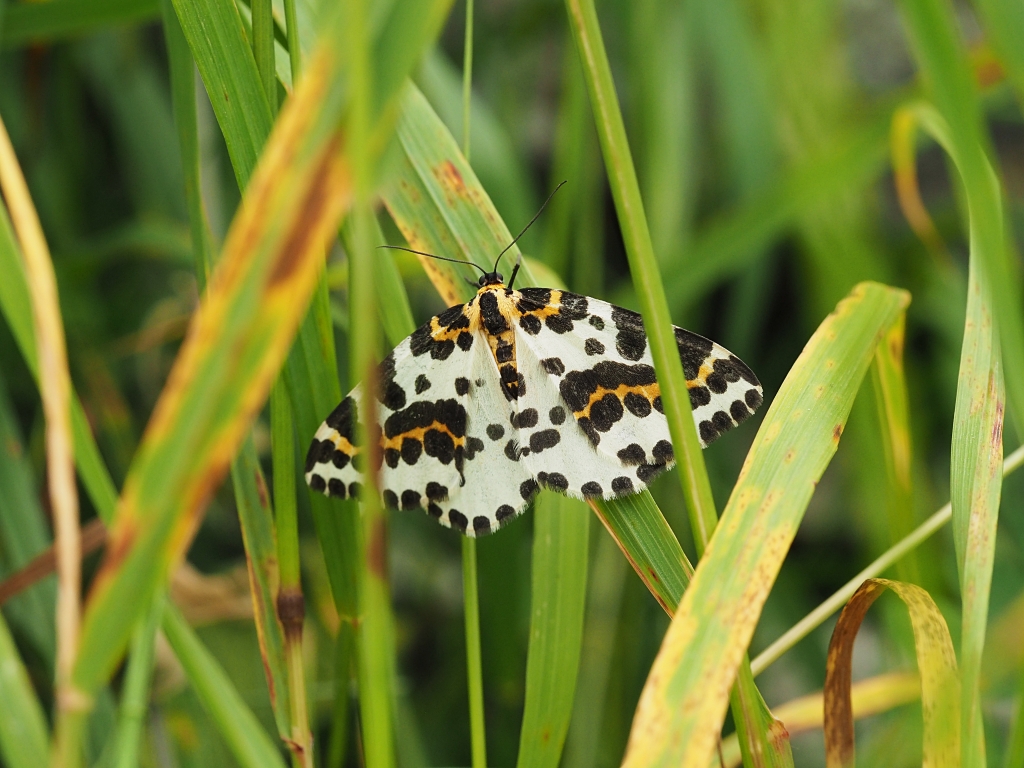
Magpie.

I failed to photograph Common Blue, of which there were a few.

But with all the common species there were a few gems. Yellow Shell is not a moth I see very often but a rather large individual eventually was photographable.

Yellow Shell.

And I think this micro is Eudonia truncicolella, not the rarer E. lineola (happy to be corrected though, although the CR would want a gen det I think).


Reidentified by SG and SS as Scoparia ambigualis, big thank you.

There were these two micros, not the best images, which I've yet to work out. 

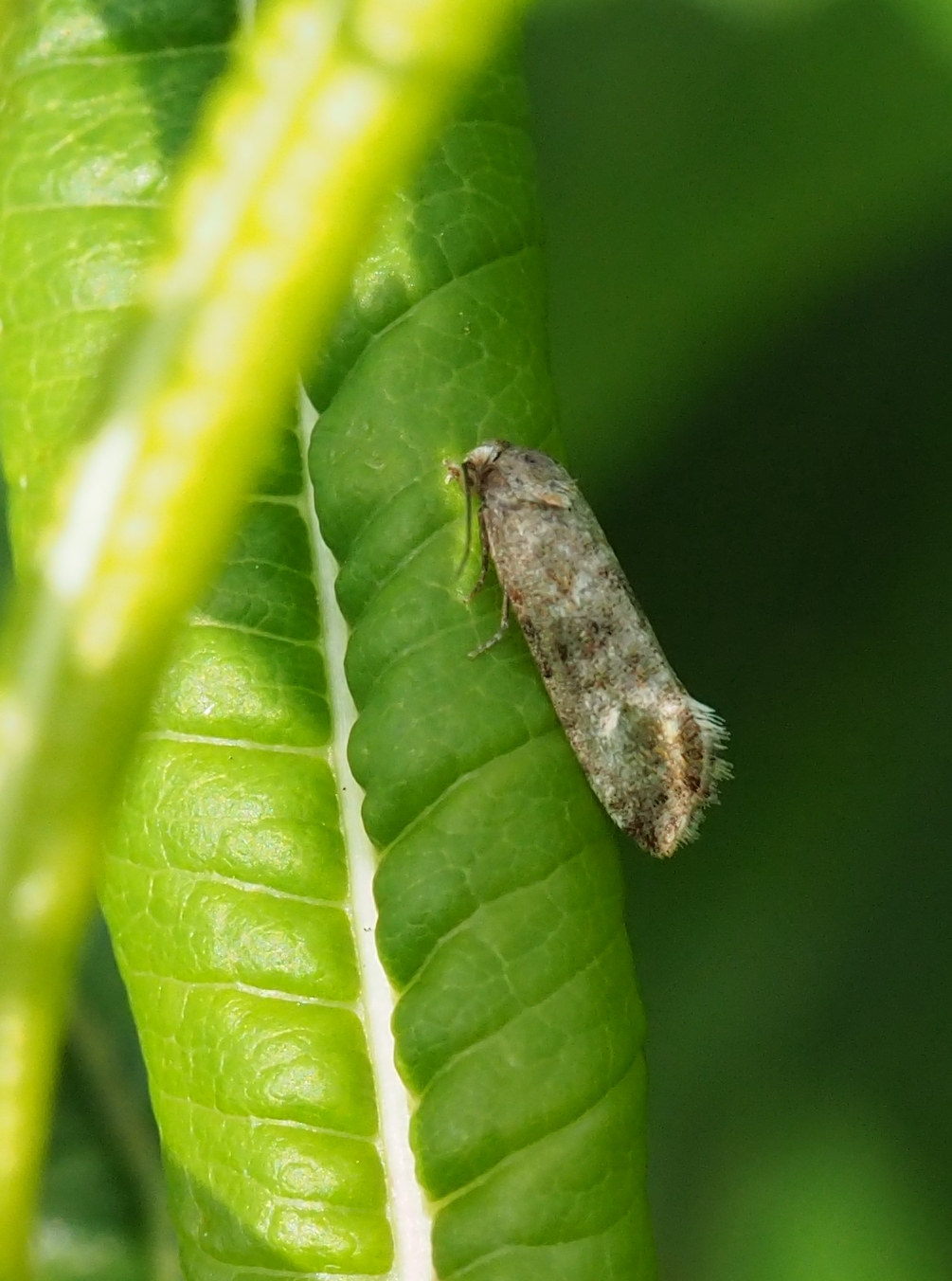
The first one is perhaps just a Timothy Tortrix seen from the side. But the second one is a challenge.

Timothy Tortrix maybe.

Unknown micro - possibly Aethes cnicana, thanks SS.

 Amongst all the moths there were a few other things, piles of the sawfly Tenthredo arcuata sl (possibly T. notha).


Tenthredo arcuata s.l. (T. notha perhaps).

The click beetle Hemicrepitius hirtus, identified by the antennae and the tiny fourth tarsal segement without a hairy pad.

Hemicrepidius hirtus.

In the interest of science I allowed myself to be bitten, twice....


Haematopota pluvialis.

Getting stuck in.

Both of these are females with the eye colour over the whole eye. You can see the antennal notch quite clearly on the second one and close-up. Males have the third antennal segement orange. It was a bit annoying for half an hour or so afterwards.

One of my favourtie things was around as well:

Amblyteles armatorius.

As well as this ichneumon there were a few Ophion sp. Yet again I'm pretty sure I saw Bombus jonellus, but no photos, so no proof. Other Bombus seen were pascuorum and lucorum s.l.

In amongst this I started to play with Google Lens. It was mentioned online the other day and there is a paper about apps for identifying things. Lens seemed to come out ok and as it is included in my Motorola I gave it a try. It is astonishingly accurate with plants, and truly hopeless with moths and other insects. On a good few occasions it came out with the correct plant identification as first choice, including things like False 0at-grass. However, the Tenthredo was identified as a Honeybee and Middle-barred Minor as a Pammene species, at least it got it to moth. The local plant recorder is about to be bombarded with my plant records which I have singularly failed to upload from "proper" photographs, sorry JC.

Plantago maritima.

Google Lens got Plantago maritima as first choice, well impressed. An interesting plant to find along the green lane, 8km inland.

Thanks to MS for mentioning Public Service Broadcasting in his blog, somehow escaped my radar. Blown away. I especially love this album.

But they're all good. Playing in Glasgow in November, very tempted to make the trip.

It is hard not to make comment about the football. Disgusting racism towards young players, and beating up our Italian guests. Let alone the laser incident and booing the Danish anthem. What is the matter with people? Actually, none of this surprises me, sadly. If you have any influence at work, or are a trade unionist, pressing for this very effective and inexpensive training by Show Racism the Red Card would be a good move....

https://www.theredcard.org/education - other training providers are available.

Thursday, 8 July 2021

Retired (nearly).

I'm still officially in post until the end of the holidays in mid-August, but I don't really have to do anything. I pretty much emptied and tidied the office the other day, a week after the end of term. Check emails once a week or so. Time to get my head around what this means. I don't feel old anyway, well mostly not, work was getting to be a struggle, just having the energy in the morning and finding it hard to find the time to do the things I wanted to do as well as work.

One thing that vexes somewhat is what to do with what's in my head, the experience and knowledge, is it useful to anyone? Or is that just ego? Hard to know at the moment.

All this in my life has left the blog unwritten and friends, mostly, incommunicado. We've had visits from two lots of old friends, and I had dos to go to. Seeing old friends after so long was fun (and a bit boozy). The work dos were in retrospect a bit overwhelming. A couple of folk who I've worked with for years phoned and were very complimentary and kind. 

My new job is full-time wildlife stuff, maybe it's time to be old, radical and a pain in the arse (after all I was very good at the PITA at work as far as some of management were concerned, so I'm well in practise).

The notebook is filling up with data again as the moth traps kick out lots of interesting things. And searching with the camera has uncovered plenty. I really wonder why I didn't buy the Olympus kit before, the macro gear is stunningly good, but perhaps I wasn't ready to take the step from the TG-4 earlier. The Jackdaws and Rooks in the roost have just woken up, noisily, maybe a Grey Heron has tried to join them, they're not keen on that occurring.

If this is Celypha rivulana it will be new for the county, I think I have it right. No I didn't it is Phiaris schulziana, thanks SG.

I also found this by searching in the Rosebay Willowherb.

It was provisionally identified as Piniphila bifasciana (thanks BS), I'd initially wondered about a Cydia but I have had a wonder about Phiaris micana, BS is most likely correct, it's with the CR now. And eventually identified as Eupoecilia angustana,

The usual crowd pleasers have begun to turn up with a very nice Acleris bergmanniana today, although it failed to pose. This Gold Spot was fresh and showed off.

Gold Spot.

One project is to put all my species on to Flickr, an Orkney invert reference place. So I'm trying to standardise the "from the trap" photos a bit, some of these things look smarter on the grey of slate, no distractions.

On the bird front, The Shunan has plenty of Shelduck chicks, an eight and a three. A third brood of Shoveler have just appeared, a five. And I suspect the Teal have well grown chicks. We had a day on Hoy where I bumped into Quail, but I will try and post a retrospective of that day shortly.

Time to nip out with the torch and see if I can find anything, the Ghosts have been dancing...